Amazon Seller Tax Deductions: The Write-Off Only Helps If the Record Survives Contact With the Books
The FBA Guys
April 15, 2026

Amazon Seller Tax Deductions: The Write-Off Only Helps If the Record Survives Contact With the Books
The dangerous Amazon seller tax deduction is the one that feels obvious in March and mysterious in October.
A software subscription. A sample order. A conference flight. A storage shelf in the garage. The PPC tool that hit a personal card because the business card was in a backpack somewhere. None of these are exotic. That is what makes them so easy to mishandle.
Amazon seller tax deductions generally include ordinary and necessary business expenses such as product costs, Amazon fees, advertising, software, supplies, professional fees, business-use portions of home office or vehicle costs, and some travel or meal expenses. The exact treatment depends on the seller's facts, entity structure, accounting method, and documentation.
That last word does most of the work.
We pulled the tax-facing fields in our valuation database because this topic lives in a strange place. The database can't tell you whether your home office qualifies or whether a product sample should be treated one way in your books. That belongs with the IRS, your CPA, and the facts. What the data can show is how much tax readiness tends to travel with business maturity.
Among 8,424 successful valuation submissions, businesses with tax returns marked available averaged $1,744,480 in indicative value. Businesses without tax returns averaged $464,760.
That is not proof that tax returns caused the higher value. Larger businesses are more likely to have tax returns, better bookkeeping, and professional help. Still, the pattern is hard to ignore. The deduction only matters if the business can explain it later.
What Amazon seller tax deductions really cover
The IRS standard for small business expenses is less glamorous than most tax content makes it sound. Business expenses generally need to be ordinary and necessary for the trade or business. For Amazon sellers, that usually means the expense has a real business purpose and is connected to selling, fulfilling, managing, or protecting the operation.
Some categories are straightforward.
Amazon referral fees. FBA fulfillment fees. Professional seller subscription fees. Shipping supplies. Product photography. PPC software. Bookkeeping. CPA work. Trademark filings. Packaging design. Product samples. A prep center. A warehouse. A barcode tool you forgot existed until the renewal email arrived like a raccoon in the ceiling.
Those are usually easier to defend because the business purpose is visible.
Other categories need more care. Home office. Vehicle mileage. Meals. Travel. Owner reimbursements. Cell phone. Internet. Equipment. Training. Mixed-use software. Expenses paid personally and reimbursed later. The more personal life can plausibly touch the expense, the more the record has to carry.
This is where Amazon sellers get into trouble. Not because they are trying to do anything wild. Because the business is operationally noisy. Amazon deposits arrive net of fees. Inventory purchases happen months before revenue. Samples move through personal addresses. Contractors get paid through three different platforms. A Prime Day push makes ad spend look like someone leaned on the keyboard.
Then tax season arrives and the seller tries to turn all of that into clean categories.
The deduction list most sellers should start with
For a typical Amazon seller, the first pass should be boring.
Boring is good here.
Start with the expenses that are directly tied to operating the store:
- Amazon marketplace fees, including referral fees, subscription fees, FBA fulfillment fees, storage fees, removal fees, inbound placement fees, and other seller charges.
- Advertising and promotion, including Amazon PPC, external ads, influencer payments, coupon costs, design work, product photography, and creative testing.
- Software and tools, including repricers, keyword tools, inventory software, accounting software, reimbursement audit tools, email tools, and analytics platforms.
- Professional services, including CPA, bookkeeping, legal, trademark, compliance, product testing, inspection, and consulting fees.
- Office and operating supplies, including labels, printers, scales, boxes, poly bags, tape, storage bins, and other materials used in the business.
- Contractor and employee costs, including VAs, creative contractors, prep-center labor, warehouse help, payroll costs, and employer-side payroll taxes when applicable.
- Banking and payment costs, including business bank fees, credit card processing fees, loan interest tied to business borrowing, and merchant service charges.
- Education and research tied to the business, when the expense maintains or improves skills used in the current business rather than preparing for a new trade.
That list won't win a tax seminar. It will catch most of the recurring items that leak out of seller books.
The better question is not "Can I deduct this?" in isolation. The better question is, "If someone opened the P&L, bank feed, Amazon statements, invoice folder, and tax return, would this expense make sense without a speech?"
That question is useful during tax season. It is even more useful when the business is being valued.
Inventory and COGS need their own treatment
Inventory is where the deduction conversation starts to get weird.
An Amazon seller buys 3,000 units in February. The cash leaves the bank. The goods sit with the supplier, move across the ocean, clear customs, hit a 3PL, then slowly sell through FBA over the next several months. The seller wants the cash outflow to behave like a normal expense because it felt like one. The books usually need more discipline than that.
For sellers that carry merchandise, product cost belongs in cost of goods sold, not casually in office expenses. That means beginning inventory, purchases, freight-in, duties when applicable, production costs, and ending inventory all matter. The tax deduction follows the goods through the year rather than behaving like a one-click software subscription.
This is why tracking COGS for Amazon FBA deserves its own system. One product order can include unit cost, freight, inspection, customs broker fees, duties, packaging, prep, and shrinkage. Some costs belong in landed cost. Some are fulfillment or selling costs. Some are period expenses. If everything gets shoved into "Amazon Misc," the tax return may still get filed, but the business stops explaining itself.
The valuation consequence is real.
SDE, or Seller's Discretionary Earnings, is the earnings metric often used for owner-operated businesses. It starts with business earnings and adjusts for properly documented owner-specific, discretionary, non-recurring, or non-cash items. Bad COGS treatment can distort gross margin, which then distorts the path to SDE.
We see the documentation side of that in the database. Tax-return availability rises with derived SDE. Among businesses under $50K in derived SDE, 71.7% had tax returns marked available. From $50K to $250K, that rose to 86.3%. From $250K to $1M, it was 90.4%. Above $1M, it reached 95.7%.
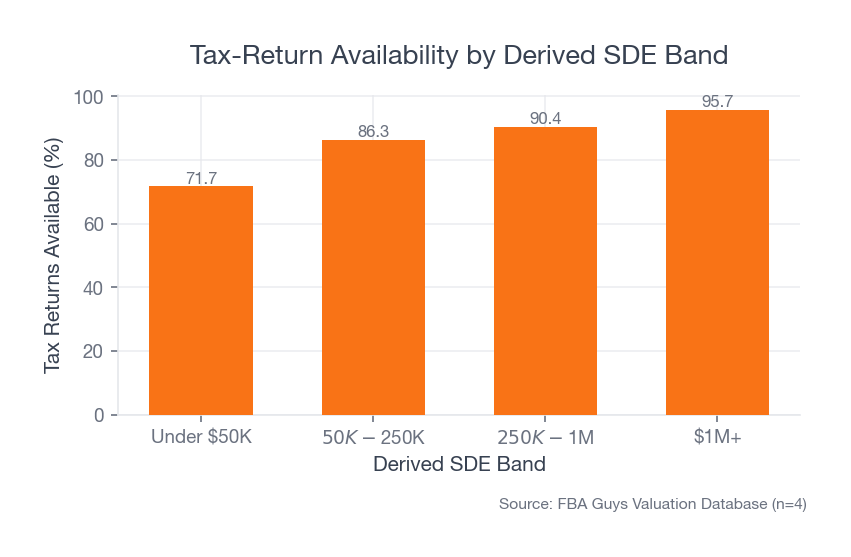 Source: FBA Guys Valuation Database (n=4 derived-SDE bands)
The pattern doesn't say larger sellers are smarter. It says that as the business gets bigger, the cost of fuzzy inventory accounting gets harder to absorb quietly.
Eventually, someone asks why January looked profitable when the inventory that produced January revenue was paid for in October. Or why gross margin changed without a price change. Or why the tax return and management P&L seem to be describing two cousins who met once at Thanksgiving.
That is a bad moment to discover the deduction system was built on vibes.
Amazon fees, ads, and software are cleaner when they stay separated
Amazon fees are usually among the easier deductions to support because Amazon records them. The hard part is getting the reports into a bookkeeping system that treats them consistently.
Referral fees, FBA fulfillment fees, monthly storage, removal fees, refund administration fees, subscription fees, and advertising charges can all move through different report lines. If the seller books only net deposits from Amazon, the P&L may hide the gross sales, fee burden, refunds, and ad spend that actually shaped the business.
That matters beyond tax.
When a buyer, lender, or valuation model looks at the business, Amazon's net deposit is too blunt. It tells you cash arrived. It doesn't tell you whether margin improved, whether ads got expensive, whether returns rose, whether storage fees started behaving like rent, or whether the business quietly bought revenue at a discount.
This is why we keep coming back to Amazon seller profit and loss statements. A useful P&L separates the business into parts someone can inspect.
Software works the same way. The seller with one repricer, one keyword tool, one accounting tool, and one reimbursement audit tool can explain the stack quickly. The seller with seventeen SaaS subscriptions across three cards needs a spreadsheet and a little humility.
No shame. We have all met the forgotten $49 monthly tool.
But if the business is heading toward a valuation, those small subscriptions become part of the earnings story. Some are true operating costs. Some may be owner-specific or unnecessary after a sale. Some are duplicated because the seller tested tools and never cancelled the losers. The tax category is only one view. The SDE view asks which costs a buyer would reasonably expect to continue.
Home office, mileage, travel, and meals need proof
The deductions sellers like talking about are usually the ones with the most personal overlap.
Home office is the classic example. IRS home office guidance generally requires business use to be exclusive, regular, and for the business, with additional rules for principal place of business or other qualifying uses. The simplified method is currently described by the IRS as $5 per square foot up to 300 square feet, but the facts still matter.
A laptop on the kitchen table doesn't become a tax strategy because Seller Central was open.
Vehicle use has the same problem. Business mileage can be legitimate when the trip is for business. Commuting and personal errands are different. The IRS publishes mileage rates by year, and the record needs the date, destination, business purpose, and miles. A shoebox full of gas receipts doesn't answer the right question.
Travel and meals require the same discipline. Business travel can be deductible when the trip is tied to the business and meets the rules. Meals are commonly limited, and entertainment is a dangerous category to treat casually. The IRS guidance for small businesses currently says most meal expenses are generally limited to 50%.
For Amazon sellers, the honest version often looks like this:
You flew to meet a supplier. You attended a trade show. You visited a 3PL. You drove to inspect inventory. You bought samples. You shipped product to a photographer. You paid a CPA to clean up state filings. You took a contractor to lunch during an actual business trip.
Fine. Keep the proof.
The weak version is the seller who turns every Costco run, every lunch, every phone bill, and every square foot of the house into a business expense because the Amazon app is on the phone. That may reduce taxable income on paper for a moment. It also creates noise.
Noise is expensive later.
Why deductions matter when your FBA business is valued
Most tax deduction articles stop at the tax return. For FBA owners, that is too early.
The same records that support deductions also support earnings quality. Buyers don't just want to know what you deducted. They want to know whether the business's profit can be reconstructed without trusting your memory.
Among the successful submissions in our database, 6,870 records reported separated business finances through the comingle proxy. Those businesses averaged a confidence score of 5.83. The 1,374 records with another known value averaged 5.41.
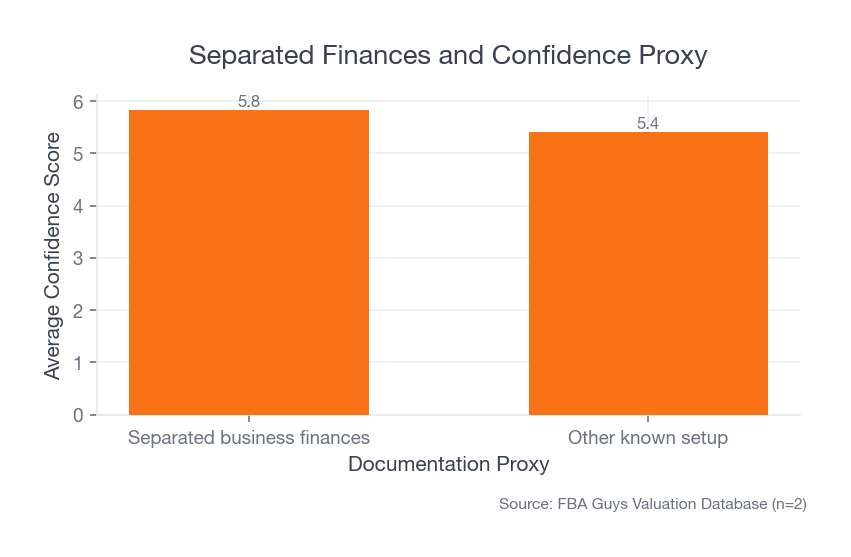 Source: FBA Guys Valuation Database (n=2 documentation proxy groups)
Again, this is a proxy. It is not an audit. But it tracks with what common sense would suggest: separated accounts make the story easier to follow.
This is where deductions and valuation meet. A seller who captures every legitimate expense may lower taxable income. A seller who captures every legitimate expense cleanly may also make SDE easier to defend. Those are related, but they aren't identical.
Some expenses reduce taxable income and reduce SDE because they are real ongoing business costs. Some expenses reduce taxable income but may be added back for valuation if they are owner-specific, non-recurring, or discretionary and properly documented. Some expenses shouldn't be in the business at all.
The add-back file is where this gets uncomfortable.
Personal phone? Maybe partially business, maybe not. Owner health insurance? Entity-dependent and fact-dependent. One-time legal bill? Maybe. Family travel attached to a trade show? Careful. A personal purchase accidentally paid from the business account? Fix it; don't build a theory around it.
A good deduction system does not try to make everything deductible. It makes the business legible.
A practical Amazon seller tax deduction checklist
Use this as a working checklist, not tax advice. The CPA still gets a vote.
- Separate business and personal accounts.
- Connect Amazon, bank, credit card, ad, and payment data to the bookkeeping system.
- Reconcile gross Amazon sales, fees, refunds, reimbursements, and net deposits.
- Track inventory separately from ordinary expenses.
- Build landed cost by SKU where possible.
- Keep invoices for product, freight, duties, inspection, prep, and packaging.
- Categorize Amazon fees consistently.
- Separate advertising from marketplace fees.
- Keep software subscriptions on the business card.
- Document contractor payments and collect tax forms when required.
- Save receipts for supplies, equipment, samples, and shipping materials.
- Keep mileage logs with date, miles, destination, and business purpose.
- Document home office use before claiming it.
- Separate meals, travel, and entertainment instead of dumping them into one bucket.
- Keep CPA, bookkeeping, legal, trademark, and compliance invoices.
- Review owner reimbursements monthly.
- Mark expenses that may become SDE add-back candidates.
- Close the books monthly, not once per year in a caffeinated panic.
The monthly close is the unglamorous hero here. If you wait until tax season, every ambiguous expense becomes a tiny courtroom drama. If you close monthly, the question is still close enough to answer.
Was that sample order for the business? Which SKU? Which supplier? Was that trip for a trade show or a family vacation with a badge lanyard attached? Did that software subscription replace another tool or duplicate it?
You know the answer in the month it happens. You may not know it eleven months later.
FAQ
What tax deductions can Amazon sellers claim?
Amazon sellers can generally deduct ordinary and necessary business expenses such as product costs, Amazon fees, advertising, software, supplies, professional services, contractor costs, business banking fees, and eligible business-use portions of home office, vehicle, travel, and meal expenses. The exact treatment depends on the seller's facts and records.
Are Amazon FBA fees tax deductible?
Amazon FBA fees are generally business expenses when they are tied to selling through Amazon. Sellers should still separate referral fees, fulfillment fees, storage fees, advertising charges, refunds, reimbursements, and net deposits so the P&L tells the truth.
Can Amazon sellers deduct inventory when they buy it?
Inventory usually needs to be handled through cost of goods sold rather than treated like a normal period expense. The timing depends on how the seller accounts for inventory, beginning and ending inventory, purchases, freight-in, duties, and other costs tied to goods sold.
Can Amazon sellers deduct a home office?
Sometimes. IRS guidance generally requires the space to be used regularly and exclusively for business, with additional qualification rules. Product storage may have separate rules in some retail or wholesale situations. Sellers should document the facts before claiming the deduction.
Do tax deductions increase the value of an Amazon FBA business?
Tax deductions don't increase value by themselves. Cleanly documented expenses can make SDE easier to verify, and defensible add-backs can affect valuation. Messy deductions can do the opposite by making the numbers harder to trust.
The cleanest deduction is the one that still makes sense after someone else opens the books.
Curious what your business is worth?
Get a free, instant valuation and see how your Amazon business stacks up.
Get Your Free Valuation