Amazon FBA Hidden Costs Most Sellers Miss: The Fee Table Is Only the Start
The FBA Guys
May 7, 2026

Amazon fees have a way of arriving in the business one harmless line item at a time, which is part of what makes them so easy to underestimate when you are still looking at product cost, referral fee, and fulfillment fee as separate boxes on a spreadsheet.
A placement charge here. A storage charge there. A return that doesn't look too bad until the unit comes back unsellable, the refund has already hit, and the replacement shipment is still three weeks from being checked in.
The Amazon FBA hidden costs most sellers miss are inbound placement, aged storage, return processing, removal and disposal, low-inventory pressure, prep and packaging drift, advertising dependence, and the working capital trapped in inventory. Some of those are literal Amazon fees, with names you can eventually find in Seller Central. Some are business costs that show up because FBA makes the operation feel cleaner than it really is.
That second group is where the article gets more interesting.
The first pass at this memo was going to make inbound placement the villain. The data wouldn't let us keep it there. Inbound placement matters, especially since Amazon now shows sellers a cost estimate for placement options when they create a shipping plan, but the database kept pointing back to a broader pattern: the sellers most exposed to fee creep were already carrying too much inventory for the earnings the inventory produced. What happens when the product already needs too much cash, moves a little too slowly, and then gets hit with one more fee on the way into FBA?
What Counts as a Hidden FBA Cost?
A hidden FBA cost is any cost that doesn't make it into your product math before the reorder decision is made, because the reorder is the moment where a quiet modeling problem turns into cash leaving the business.
That definition matters because Amazon's public fee table is not the same thing as your unit economics. Amazon can list fulfillment cost, monthly storage, aged inventory, return processing, removal, disposal, liquidation, and inbound placement as separate categories on its Fulfillment by Amazon page. Your P&L still has to absorb them through the same SKU.
When you are checking whether a product works, the question isn't only "what does Amazon charge?" The better question is: how many things have to go right before this product earns what the spreadsheet says it earns? If the answer requires perfect sell-through, clean returns, no receiving delays, no packaging drift, and no storage overhang, the unit economics are already asking for quite a lot.
1. Inbound Placement: The Fee That Made Shipping Plans Feel Different
Amazon describes the FBA inbound placement service as the cost of distributing standard-size and large bulky inventory to fulfillment centers closer to customers. When you create a shipping plan, Amazon says you will see estimates for available inbound placement options, and the charge is assessed after the shipment is received based on inbound location and quantities received.
That is a real fee. It belongs in your landed-cost and reorder math. We wrote a deeper guide to the Amazon FBA inbound placement fee because this one charge changed how a lot of sellers think about replenishment, and it has the useful habit of forcing a question that should have been asked anyway: is this shipment plan cheap, or is it merely convenient?
It also changes behavior. If you choose fewer shipment splits because it is administratively easier, the placement fee can become the price of convenience. If you choose more splits to reduce the fee, the business may take on more prep work, more carton discipline, more shipment tracking, and more chances for a box to be the one box everyone forgets about until receiving is late.
Honestly, this is why fee math gets annoying. The cheapest option on the screen isn't always the cheapest operating decision, and the business only finds out after the warehouse, the prep center, and Seller Central have all taken their turns with the same replenishment plan.
2. Storage: The Slow Cost That Punishes Stale Assumptions
Amazon's public FBA page says storage costs are charged monthly based on the average daily volume your inventory occupies in fulfillment centers. As of this writing, the public page lists higher standard-size storage rates in October through December than in January through September, and it also lists aged inventory charges for items stored more than 181 days.
That is the visible part.
The operating cost starts earlier, when the reorder quantity was based on a launch-month assumption that nobody has updated. The product used to sell 900 units a month. Then ranking softened, a competitor matched the bundle, ads got more expensive, and the next purchase order still went out for 900-unit demand because the spreadsheet cell had not been touched since February. How many storage problems begin as one stale demand assumption that looked harmless because last month still had enough sales to make the dashboard feel normal?
Now storage isn't a surprise. It is a delayed receipt.
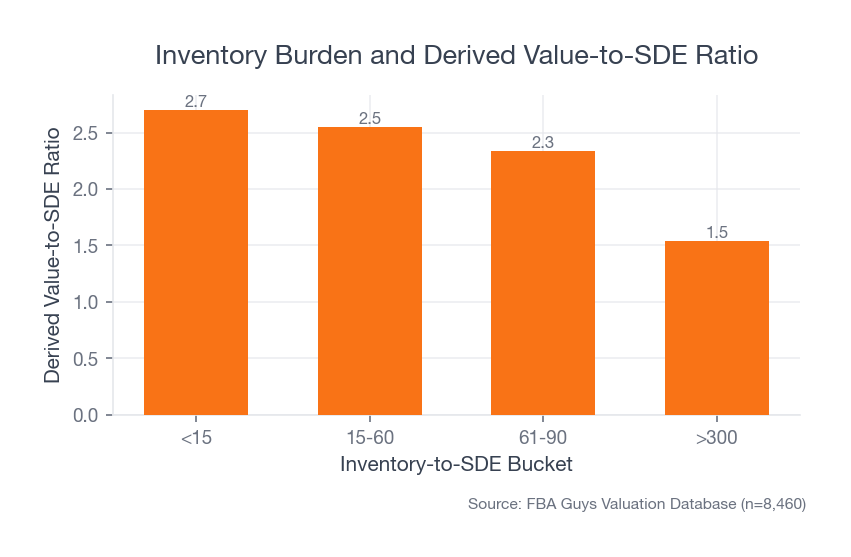
In the FBA Guys valuation database, the inventory-burden pattern is difficult to ignore. Businesses in the <15 inventory-to-SDE bucket showed 57.1% average gross margin and a 2.70 derived value-to-SDE ratio. Businesses in the >300 bucket showed 34.7% average gross margin and a 1.54 derived value-to-SDE ratio. The fee table didn't create that spread by itself, of course, but it shows why an extra storage or placement charge lands differently depending on how much inventory the business already needs to create a dollar of earnings.
 Source: FBA Guys Valuation Database (n=8,460)
The exact Amazon storage charge is time-sensitive. The inventory habit underneath it is much more durable. Our storage fee guide goes deeper on why monthly and aged storage fees are measuring different inventory problems, but the practical rule is simple enough: storage cost should push you back into reorder logic, not just into the fee report.
3. Returns Processing: The Cost of a Sale That Didn't Stay Sold
Amazon's FBA page lists returns processing among other FBA costs and describes it as charged on orders when Amazon provides a customer with free return shipping.
A return is rarely just a return, especially when the model treated every order as if the sale stayed sold forever.
There is the refund. There may be a returns processing fee. There may be an unsellable unit. There may be a repackaging issue that moves the product into a slower, uglier corner of the operation. If the category has enough return volatility, you also have a forecasting problem because sales volume and kept sales are no longer close enough to use interchangeably. What does your margin look like after you count the orders that came back, the units that didn't return to sellable condition, and the replacement inventory you had to order before the return file was fully understood?
This is where "free returns" becomes a phrase for the customer and a math problem for the seller.
4. Removal, Disposal, and Liquidation: The Cleanup Costs
Amazon lets sellers remove, dispose of, or liquidate inventory in fulfillment centers for a per-item charge, which sounds like an administrative cleanup option until you remember the unit has already consumed product cost, freight, placement, storage, and management attention.
This section is short because the lesson is simple. If the product only works when every unit sells through cleanly, it doesn't work yet, and you shouldn't let a liquidation button make the original buying decision look more disciplined than it was.
Removal and disposal costs usually arrive after the business has already paid for product, freight, prep, placement, storage, and attention. They feel like cleanup. They are often the last visible sign that the buy quantity was wrong months ago.
5. Low Inventory, Stockouts, and the Cost of Staying Available
Low inventory gets discussed as a fee problem. It is also a sales-continuity problem, and sometimes the cost of avoiding storage is that you teach the listing to become unreliable right when demand was starting to prove itself.
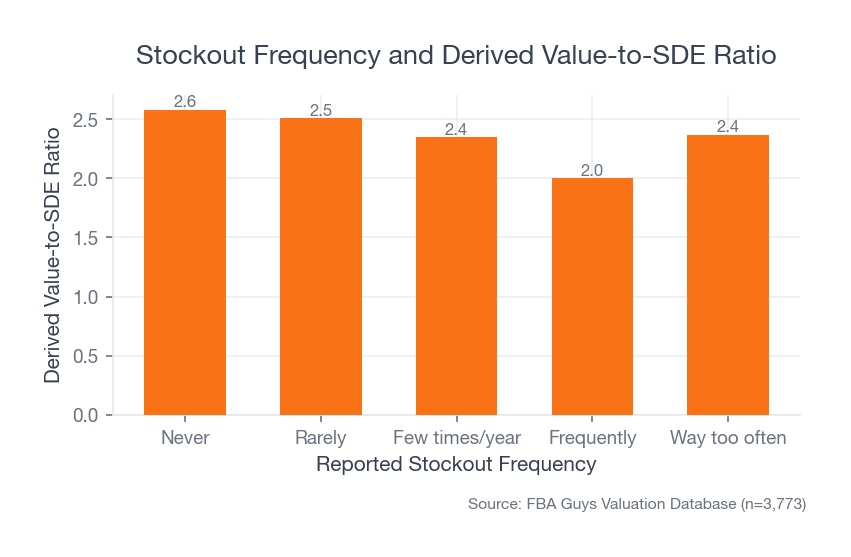
In our data, businesses that reported they were never out of stock had a 2.58 derived value-to-SDE ratio. Businesses that were frequently out of stock showed 2.00. The margin difference was not dramatic enough to explain the whole gap: 49.0% average gross margin for the "never" group and 46.2% for the "frequently" group. That kind of gap usually points to a business-quality issue rather than one isolated fee line.
 Source: FBA Guys Valuation Database (n=3,773)
What is the number measuring? Probably not one thing. Stockouts can signal weak forecasting, cash tightness, supplier issues, demand volatility, or a seller who is trying to dodge storage cost by running too lean. The fee may be the visible nudge. The hidden cost is the business becoming harder to trust, because a product that can't stay available typically has a deeper planning problem sitting behind the Seller Central alert.
How much inventory should you carry, then?
Enough to protect the sales you can profitably fulfill, not so much that you are paying Amazon to warehouse your optimism. That answer is irritatingly product-specific, but so is the cost.
The Cost That Doesn't Look Like a Fee: Inventory Load
This is the part that should make sellers slow down before obsessing over a single rate line, because a fee only becomes expensive in context.
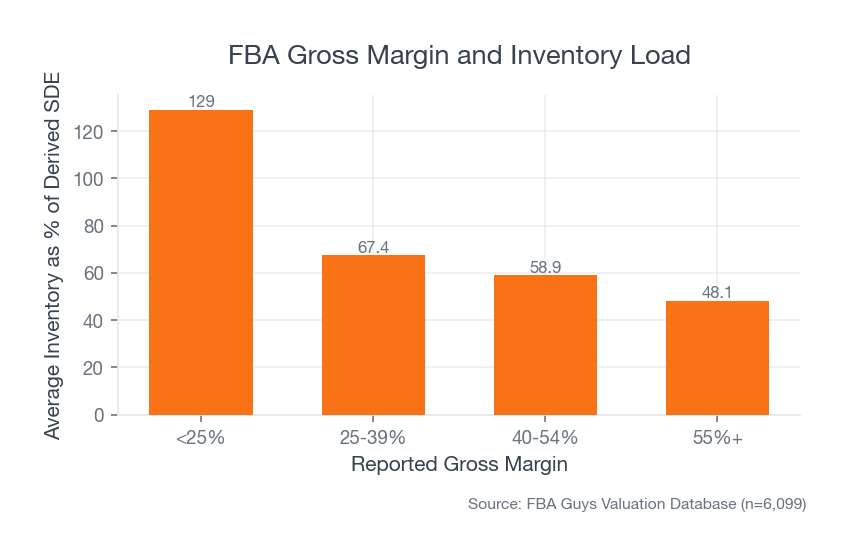
Among FBA businesses in our usable valuation set, the lowest gross-margin bucket carried the heaviest inventory load relative to earnings. FBA businesses below 25% gross margin had average inventory equal to 128.9% of derived SDE. FBA businesses at 55% or higher gross margin averaged 48.1%.
 Source: FBA Guys Valuation Database (n=6,099)
Same platform. Very different room for error.
A 40-cent fee doesn't matter the same way in those two businesses. In the low-margin business, the product is already using more cash to create less earnings. You are paying for product earlier, waiting for inventory to move, absorbing Amazon fees, and hoping the next reorder doesn't land just as demand softens. If the product has to be reordered in large batches, the cash-cycle problem gets even less forgiving because the next purchase order arrives before the last cost lesson has fully shown up in the books.
This is why the true cost of selling on Amazon has to be measured by SKU and by cash cycle. A fee table can tell you what Amazon charges. It can't tell you whether your business has enough gross margin, turn speed, and pricing power to survive the whole path from purchase order to kept sale. A landed cost calculator helps with the front half of that math; the rest has to come from your actual fee reports and reorder behavior. Are you measuring the SKU after the cash comes back, or only before the purchase order goes out?
Of course, that makes the math less satisfying. It also makes it more useful.
6. Prep, Labeling, Packaging, and the Dimensional Weight Tax You Created Yourself
Some FBA costs begin before Amazon receives the unit.
Prep work, labels, cartons, poly bags, inserts, carton configuration, dimensional weight, and third-party prep fees all have a way of sitting outside the clean product-cost cell. If those costs are handled by a supplier, they can get buried in the invoice. If they are handled by a prep center, they can sit in a separate vendor bill. If they are handled internally, they may disappear into labor, which is the most dangerous version because the cost feels like "our time" until the owner is spending Friday afternoon relabeling a carton configuration that should have been fixed upstream.
The unit doesn't care where you hid the cost.
Packaging is the awkward one because it can create two problems at once. A box that protects the product but bumps the item into a larger size tier may be rational for reviews and irrational for margin. A box that saves on dimensional weight but increases damage rate may win the fee table and lose the return file. Which one is cheaper? You won't know unless packaging, damage, return rate, and fulfillment cost are being reviewed together rather than by whichever vendor invoice happened to arrive first.
You need the product to arrive intact, fit its economics, and stay boring in Seller Central. All three matter. If package size is part of the issue, use the dimensional weight calculator before the next packaging change becomes a permanent fee increase.
7. Advertising Dependence: The Cost That Can Pretend to Be Growth
Advertising is not an FBA fee, but it belongs in this conversation because many FBA products are only profitable after you know how much demand had to be purchased, and paid demand can make a weak SKU look healthier for a while than its kept-sale economics deserve.
The database is not strong enough here to make a broad valuation claim. Most records don't have reliable advertising-spend data, and the populated subset is too small to carry the article. That limitation is useful. It keeps us from pretending paid traffic is always waste or always growth.
At the SKU level, the question is narrower: after referral fees, FBA fulfillment, placement, storage, returns, prep, and ads, does the unit still produce contribution margin you would be willing to reorder with your own cash? If the answer changes depending on whether you include last month's coupon, last quarter's returns, or the latest placement estimate, the model is probably too clean.
If you can't answer that by SKU, Amazon's reports are running the business louder than your P&L is.
How to Calculate the Real All-In Cost of an FBA Unit
Use a simple sequence. Keep it boring.
Start with product cost, including freight-in, duties, prep, and packaging. Add Amazon referral fees and FBA fulfillment fees. Add inbound shipping and inbound placement assumptions from the actual shipment plan, not last quarter's memory. Add expected storage by month, including seasonal storage if inventory will sit into Q4. Add returns using kept-sale economics, not gross sales. Add removal, disposal, or liquidation assumptions for slow movers. Add advertising required to produce the sale. Then compare the final contribution margin against reorder cash, lead time, and inventory turn. You are trying to answer one rather specific question: after the product survives Amazon's whole operating path, is there still enough profit and cash velocity to justify buying it again?
Amazon's pricing page and Revenue Calculator are useful starting points, but Amazon also says calculator results are estimates and actual costs may vary. That caveat should live in your model too.
That last step is where most of the value is.
If the SKU earns a nice margin but needs nine months of inventory on hand, the cost didn't disappear. It moved from the fee report into working capital, where it becomes easier to ignore and much harder to unwind.
FAQ
What are the most common Amazon FBA hidden costs?
The most common hidden costs are inbound placement, storage and aged inventory, return processing, removal and disposal, prep and labeling, dimensional-weight changes, low-inventory pressure, stockouts, and advertising required to keep sales moving. The fees matter, but the bigger question is whether you are measuring them before you reorder or only after they have already reduced the margin.
Is inbound placement the biggest hidden FBA cost?
Sometimes. For many sellers, inbound placement is the fee that finally makes the problem visible, but inventory burden is often the larger economic issue. A product with thin margin, slow turns, and frequent reorders can be fragile before the placement fee ever appears, so don't let the newest fee distract from the older cash-cycle problem.
How often should I update FBA cost assumptions?
Update them whenever Amazon changes fees, whenever packaging changes, whenever a supplier cost changes, and before every meaningful reorder. If you only update the model after the P&L looks strange, the purchase order has already been sent. A monthly review is typically enough for stable SKUs, but a product with volatile ads, returns, or storage exposure deserves a check before cash leaves the business again.
Should I avoid FBA because of hidden costs?
No. FBA can still be the right fulfillment method. The reality is that FBA works best when the seller understands the full unit economics instead of treating fulfillment, storage, placement, returns, and inventory cash as separate small problems.
Curious what your business is worth?
Get a free, instant valuation and see how your Amazon business stacks up.
Get Your Free Valuation