Amazon FBA Removal Order Fees: The Small Fee That Shows Up Late
The FBA Guys
May 9, 2026

Amazon FBA removal order fees usually arrive after the real decision has already been made.
A seller bought too much. A SKU slowed down. A package redesign missed the season. A launch that was supposed to clear 800 units cleared 217, and now Seller Central is politely asking whether those boxes should keep sitting in an Amazon fulfillment center like they are paying rent on a studio apartment.
Amazon FBA removal order fees are per-unit charges for having Amazon return inventory from a fulfillment center to you or another address. As of this writing, Amazon also treats disposal and liquidation as separate options for clearing FBA inventory, each with its own cost mechanics. The exact fee depends on size tier and shipping weight, and sellers should verify the current rate card inside Seller Central before placing a large removal order.
That is the practical answer. The more useful answer is that removal fees are rarely the largest cost in the room.
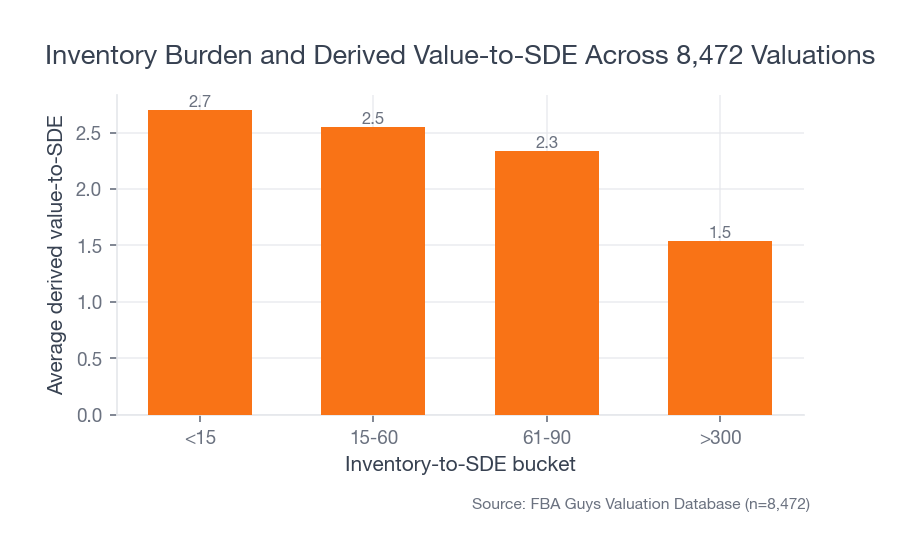
In our valuation database, businesses with the lightest inventory-to-SDE burden averaged a 2.70 derived value-to-SDE ratio. Businesses in the heaviest bucket averaged 1.54. The removal order didn't create that gap. It just made the inventory problem visible.
What Amazon FBA removal order fees are
A removal order asks Amazon to take units out of FBA inventory and send them somewhere else. That might be your warehouse, a 3PL, a prep center, or another address you control.
Amazon's public FBA cost page groups removal, disposal, and liquidation orders under "Other FBA costs" and describes them as per-item charges for inventory in a fulfillment center. The fee is tied to the unit, not the parent ASIN, the emotional pain of the failed launch, or how badly you would like those boxes to disappear.
What changes the fee?
- Size tier
- Shipping weight
- Whether you remove, dispose, or liquidate
- Current Amazon rate-card rules
- Whether Amazon processes units in batches over time
The last point matters more now for your books than it used to. Amazon announced that effective March 1, 2026, FBA removal and disposal fees are charged on a per-unit basis as each unit is removed or disposed of. Amazon described the change as a billing-timing change, with rates unchanged.
In plain English: the fee can show up as units process rather than waiting for the whole order to finish. That can make reconciliation easier if your books are clean and more annoying if they aren't.
Current Amazon FBA removal order fees
Current Amazon FBA removal order fees should be checked in Seller Central before you place the order. Amazon's public pages are useful for understanding the mechanics, but the actual rate you should use comes from the current Seller Central fee table and your product's size and weight classification.
This is where removal fees get a little sneaky. A per-unit charge can sound small in isolation, but then you multiply it by 1,900 units of a product that sells for $11.99 and has already eaten inbound freight, inbound placement fees, storage, ads, and a little of your patience.
Now the fee has a personality, and if your accounting system doesn't separate removal, disposal, liquidation, storage, returns processing, and ordinary fulfillment fees, you won't know whether you had one bad cleanup month or a SKU-level margin problem that has been hiding in the blended Amazon fee line.
Removal vs disposal vs liquidation
Removal means Amazon sends the inventory back out of FBA. You still own it. You can inspect it, relabel it, bundle it, send it to another channel, store it at a 3PL, or decide later that you were only postponing disposal with extra steps.
Disposal means Amazon gets rid of it. The unit is gone. You pay the applicable disposal fee and stop paying storage on that unit.
Liquidation means Amazon attempts to recover some value through liquidation channels. Liquidation can include a processing fee and a referral fee on the recovery value, so it can be useful when the product still has value but isn't worth the operational work of pulling it back, inspecting it, and trying to sell it yourself.
Which option is best?
Start with the resale path. If the product can be sold profitably somewhere else, removal may preserve value. If the product is damaged, expired, obsolete, restricted, or worth less than the handling work, disposal may be cleaner. If the product has enough residual value but not enough attention left in your business, liquidation might be the middle path.
This is not just a fee comparison. It is an attention comparison.
The inventory has to earn the next hour you spend on it. That sounds a little cold until you are looking at cartons that need receiving, sorting, inspection, relabeling, repricing, and another storage decision before a single unit can turn back into cash. If you don't make the next step explicit before the removal order, you haven't rescued inventory; you have changed its address.
The fee is small. The inventory signal is bigger.
The valuation data kept pulling the article away from the rate table.
Among 8,474 successful valuations in the FBA Guys database, the businesses with the lightest inventory burden looked different from the businesses carrying the heaviest burden. In the <15 inventory-to-SDE bucket, 2,389 businesses averaged 57.1% gross margin and a 2.70 derived value-to-SDE ratio. In the >300 bucket, 1,415 businesses averaged 34.7% gross margin and a 1.54 derived value-to-SDE ratio.
 Source: FBA Guys Valuation Database (n=8,472)
That doesn't mean removal fees caused the difference. They didn't. The database doesn't track removal orders at all.
It means removal fees often appear at the end of a much longer inventory story: overbuying, weak sell-through, poor SKU retirement discipline, too much optimism after one good month, or a product that needed a mercy killing three purchase orders ago.
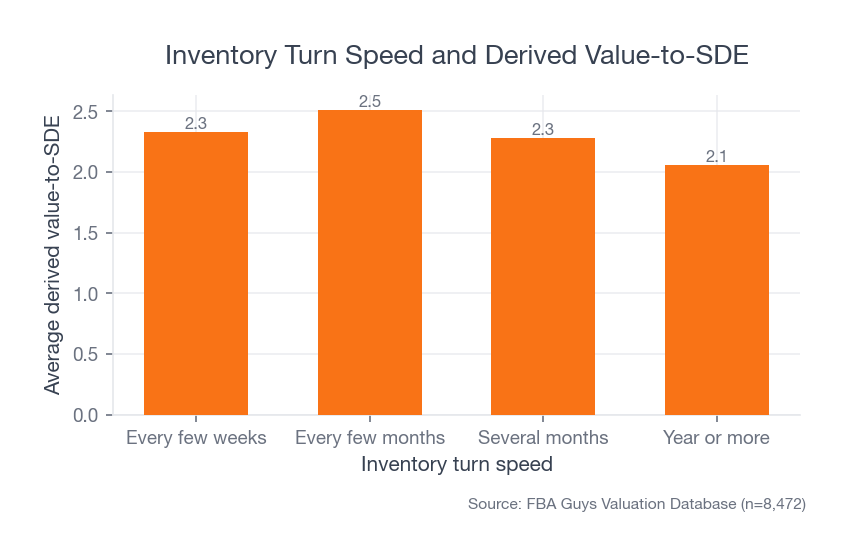
The slow-turn data made this harder to wave away. Businesses that turned inventory only once a year or more still showed 53.7% average gross margin, which looks healthy until you remember that the margin is sitting inside slow cash conversion, aged inventory risk, and a product line that may need to be pulled back from FBA before Amazon starts collecting more rent. We covered the storage side of that problem in more detail in the breakdown of monthly vs long-term FBA storage fees.
 Source: FBA Guys Valuation Database (n=8,472)
High margin can hide a stale SKU for a while, but the boxes are still there when the spreadsheet stops being flattering.
This is the part of the analysis that made us slow down. A high-margin product with slow turns doesn't always feel like a problem inside the business because each unit still looks profitable when it sells, but the business has to carry the capital, the storage exposure, the operational clutter, and the decision fatigue while waiting for that sale to happen. If you only look at margin, the SKU gets another chance. If you look at cash conversion and inventory burden, you may decide it has already had several.
When removal makes sense
Removal makes sense when the inventory still has a job to do outside FBA.
Maybe the SKU sells better on Shopify, needs a new label, should sit in cheaper seasonal storage until the next window, or deserves a quality inspection before more returns damage the listing. Maybe Amazon's measurements pushed the product into the wrong fee tier and you need to reset the physical facts before you send it back in.
Removal gets expensive when the plan after removal is vague.
Where is it going, what will the 3PL charge to receive it, how much inspection is needed, will you pay pick-and-pack again, and who is making the decision on each carton when the prep center sends photos that somehow make every box look more tired than you remember?
That last one is not in the model, but it is real enough.
The mistake is treating the removal order as the plan. The removal order is the truck ride. The plan is what happens after the truck arrives.
You don't need an elaborate model for every small cleanup. You do need enough discipline to keep a removal order from becoming an unmarked pile in another warehouse, because that is how a Seller Central problem quietly becomes a 3PL invoice, a stale Shopify clearance page, and a monthly reminder that nobody wants to make the final call.
How to model removal fees before you place the order
Use a simple SKU-level calculation before creating the order:
- Units to remove
- Amazon removal fee per unit
- Receiving cost at the destination
- Inspection, relabeling, or prep cost
- New storage cost
- Expected resale value
- Time required to recover cash
Then ask the uncomfortable question: would you buy this inventory again today at the cost of getting it back into your control?
If the answer is yes, removal may be rational. If the answer is no, disposal or liquidation deserves a real look. Sellers sometimes keep paying to preserve the illusion that the original purchase order can still be rescued.
Of course, you also have to avoid the opposite mistake. Cutting inventory too aggressively creates stockouts, and stockouts are ugly in the data too. Businesses reporting frequent stockouts averaged a 2.00 derived value-to-SDE ratio, compared with 2.58 for businesses reporting no stockouts.
Inventory discipline lives between those two mistakes.
Too much inventory creates removal orders. Too little inventory creates lost sales, ranking interruptions, and a buyer asking why the sales chart looks like stairs with missing steps. The same logic shows up in Amazon FBA unit economics: a unit only works when it survives the whole business, not just the fee row you happened to notice first.
So the model shouldn't stop at "remove or don't remove." It should ask what you are protecting: cash, rank, warehouse space, review quality, the listing, or the management attention that should be going toward products with a cleaner future. A removal fee can be perfectly rational when it protects one of those things, and it can be wasteful when it simply keeps a weak SKU emotionally alive for another quarter.
What buyers see in removal-heavy inventory
Buyers don't care about a one-time cleanup fee in isolation. They care about what the cleanup says about the business.
A one-off removal order before peak season might look disciplined. A recurring pattern of aged inventory, disposal, and relabeling charges looks like the SKU catalog is managing the owner instead of the other way around.
The cleaner story sounds boring: "We remove slow SKUs every quarter, route seasonal units to cheaper storage, liquidate products under a defined recovery threshold, and reconcile every movement against Seller Central and the books."
That sentence will never go viral, which is fine because it also won't make a buyer reach for a calculator with suspicion.
The messy story is more familiar:
"Some of this inventory is old, but it should still sell."
Maybe it will and maybe it won't, but the fee table can't answer that for you.
Your records should. If you can show when the units arrived, when velocity changed, what threshold triggered removal, where the inventory went, and how the cash recovery compared with disposal or liquidation, the removal order becomes part of a controlled inventory system. If you can't show that trail, a buyer has to guess whether the cleanup was discipline or drift.
FAQ
What are Amazon FBA removal order fees?
Amazon FBA removal order fees are per-unit charges for having Amazon return inventory from a fulfillment center to you or another address. The fee depends on size tier and shipping weight, and Amazon's current Seller Central rate card should be checked before placing a large order.
Are FBA removal fees the same as disposal fees?
They are often listed together and can use the same size-and-weight fee structure, but the outcome is different. Removal sends inventory back out of FBA. Disposal gets rid of it. The accounting and business decision are not the same even when the per-unit charge looks similar.
When did Amazon change how removal and disposal fees are charged?
Amazon announced that effective March 1, 2026, FBA removal and disposal fees are charged per unit as each unit is removed or disposed of. Amazon described this as a timing change, not a rate change.
Should I remove, dispose of, or liquidate FBA inventory?
Remove inventory if it has a profitable next use outside FBA, dispose of it if the product is worth less than the work and cost of recovery, and consider liquidation when there is residual value but the SKU doesn't deserve more operating attention from you.
The removal fee is the receipt
Amazon FBA removal order fees are easy to calculate after you know the size tier, shipping weight, and unit count; the harder work is deciding what the fee is telling you.
If a removal order clears out a bad buy and protects the rest of the business, pay it and move on. If removal orders keep appearing because the catalog has no retirement discipline, the fee is just the receipt for an inventory habit that has been costing money for months.
The boxes were already expensive before Amazon charged to move them.
Curious what your business is worth?
Get a free, instant valuation and see how your Amazon business stacks up.
Get Your Free Valuation