Amazon FBA vs FBM Cost Comparison: Cheap Fulfillment Is the One That Fits the SKU
The FBA Guys
May 8, 2026

The neat version of the Amazon FBA vs FBM cost comparison fits in a table, where FBA has fulfillment fees, storage fees, inbound placement headaches, and Amazon-controlled service levels, while FBM has postage, packaging, labor, software, late-shipment risk, and the quiet irritation of being responsible for every box that leaves the building.
In our valuation database, pure FBM businesses are only 4.3% of successful submissions. FBA shows up in 72.1%. The hybrid model, where sellers use both, is 23.1%. That alone says something useful: most Amazon businesses don't treat FBM as the default replacement for FBA. They treat it as a specific tool.
The cost comparison should start there.
FBA is usually more expensive on the visible fee line, but FBM can become more expensive inside the operating model, especially when your time, delivery reliability, customer-service load, warehouse discipline, and eventual transferability get counted honestly.
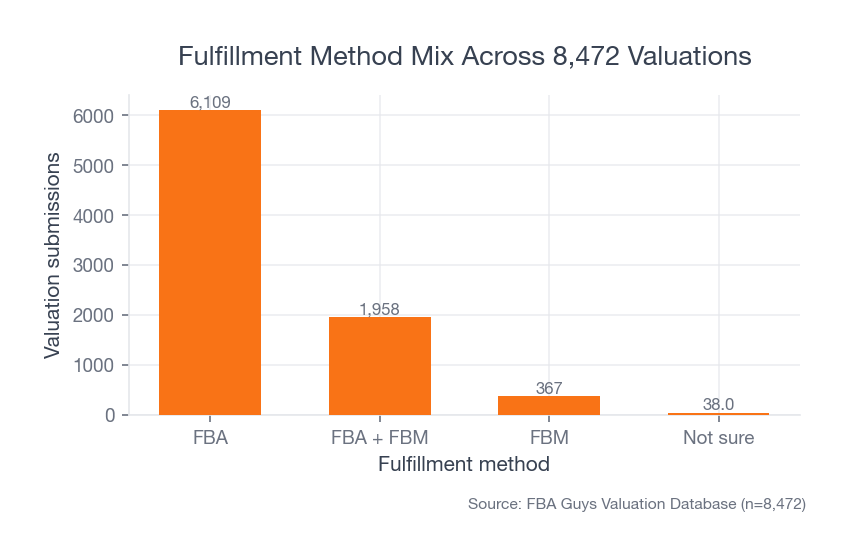 Source: FBA Guys Valuation Database (n=8,472)
Amazon FBA vs FBM cost comparison starts with the job the SKU needs done
FBA means Amazon stores the inventory, picks it, packs it, ships it, handles much of the customer service flow, and makes the offer eligible for Prime when the product qualifies.
You pay for that infrastructure through FBA fulfillment fees, storage fees, inbound placement fees and other current charges listed in Amazon's pricing materials, so the bill feels wonderfully explicit right up until a slower SKU starts collecting costs in three different places.
FBM means you keep control.
You store the inventory or use a third-party warehouse, buy shipping, pack the order, meet the delivery promise, handle more of the operational friction, and keep your seller metrics clean, which can feel liberating if you already have the process built and exhausting if you are inventing the process after orders start coming in.
The fee line can look friendlier because Amazon isn't charging the same fulfillment fee, but the work moved somewhere else: to the warehouse shelf, the employee schedule, the Friday afternoon carrier pickup, and the customer who ordered two units and then messaged twice because the tracking number didn't scan until 11:43 p.m.
That last detail sounds tiny until you are the person refreshing the carrier page.
What FBA charges for
FBA charges for convenience, speed, and a system you don't personally operate every day.
The obvious costs are fulfillment fees and monthly storage, and depending on the product, you can also run into aged inventory fees, removal or disposal fees, inbound placement fees, prep services, returns processing, and the ordinary referral fees that apply whether you use FBA or FBM.
For a clean cost model, separate the layers:
- Selling plan and referral fees.
- FBA fulfillment fees.
- Storage and inventory-aging fees.
- Inbound freight, placement, prep, labeling, and removals.
- The cash cost of keeping enough inventory in the network.
If you want the mechanics underneath the second and third lines, the FBA fulfillment fee breakdown and monthly versus long-term storage fee guide are the two better starting points.
That last line is where too many FBA comparisons get lazy, because the fulfillment fee is a transaction cost while inventory is a balance-sheet problem that turns into an operating problem when the SKU slows down, the cash sits, and the seller starts making marketing decisions around product that needs to move rather than product that deserves more spend.
We see this in the valuation data.
Among FBA businesses with inventory below 0.25x derived SDE, average value-to-SDE was 2.78; once inventory rose above 1.5x derived SDE, average value-to-SDE fell to 1.54, which doesn't prove inventory burden caused the lower valuation but does show that heavy inventory and lower valuation ratios often travel together.
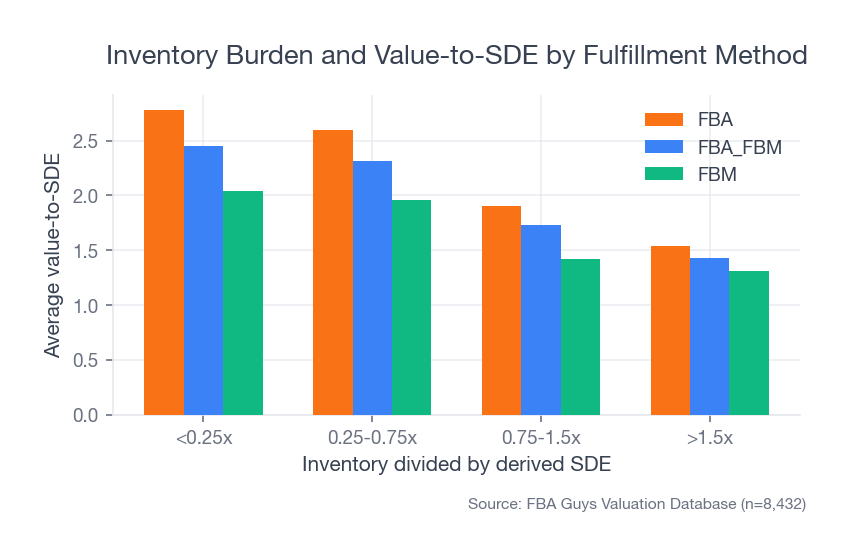 Source: FBA Guys Valuation Database (n=8,432)
What FBM charges you for
FBM charges in less standardized ways, and that is why it can fool you when you compare it against FBA with a calculator that only knows how to add Amazon fee lines.
Postage is easy to count, but boxes, tape, labels, dunnage, returns, warehouse space, pick-pack labor, software, insurance, carrier adjustments, and missed-service recovery take more discipline because some of those costs sit in a clean P&L line, some hide inside payroll, and some show up as owner time, which has a magical habit of becoming "free" in small-business math.
The fact is, FBM can be a better economic model when the SKU is awkward for FBA. Oversized products, fragile items, slow movers, products needing inspection before shipment, or SKUs where you already have warehouse capacity can work quite well under merchant fulfillment.
FBM also gives you more control over packaging and customer experience. If the box presentation matters, if bundling changes order by order, or if you need a human to check something before shipment, FBM can preserve margin that FBA would chew up through fees or inflexibility.
But the control has to be worth the operating load, and you shouldn't give that labor a zero just because the work happens after dinner or between other tasks.
In our data, 72.4% of FBA businesses reported 15 hours or less of weekly workload. FBM and hybrid businesses both landed at 43.3%. At the high-workload end, 35.7% of FBM businesses reported 31+ hours per week, compared with 12.4% of FBA businesses.
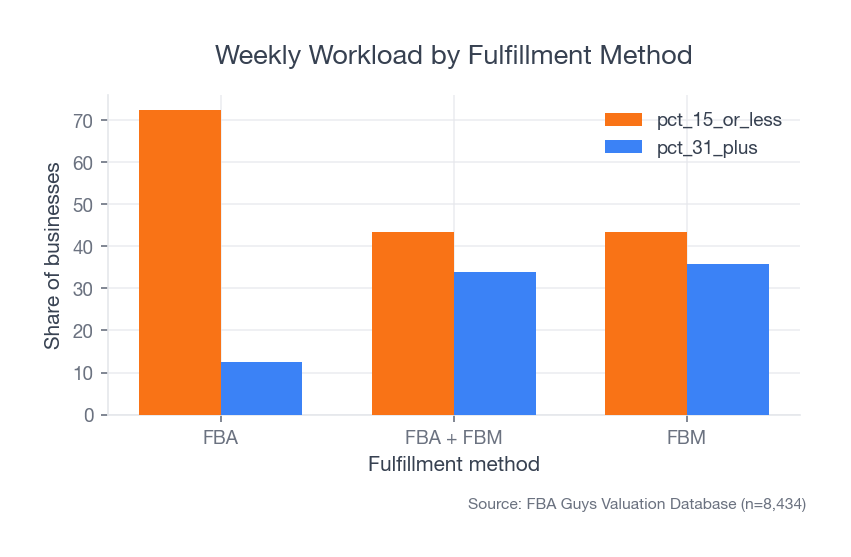 Source: FBA Guys Valuation Database (n=8,434)
The strange part: FBM shows higher margin and lower value-to-SDE
This is the finding that makes the cost comparison more interesting, mostly because it refuses to let either side of the argument win cleanly.
FBM businesses in the database show an average gross margin of 50.0%, while FBA businesses show 45.2%, and on that number alone, FBM looks better because more margin should feel like more room to breathe.
Then the valuation ratio changes the mood.
Median value-to-SDE is 2.68 for FBA businesses and 1.64 for FBM businesses, while hybrid businesses sit in the middle at 2.22, which is a fairly sharp reminder that a business can look better at gross margin and still look harder to own.
There are several possible explanations, and the database won't let us isolate all of them.
FBM sample size is smaller, some FBM businesses may be in categories where fulfillment control is necessary because the product is operationally difficult, some may be less transferable because the warehouse workflow depends on the owner, and some may carry customer-service expectations that a buyer has to rebuild after closing.
The useful conclusion is narrower and more defensible: gross margin doesn't finish the cost comparison, because you can save on FBA fees and still create a business that is harder to operate, harder to transfer, or harder to value cleanly.
That is the same reason unit economics need to be read as a system, not as one fee line. The Amazon FBA unit economics guide goes deeper on that.
Where FBM can still win
FBM deserves more credit than most FBA-first sellers give it, especially when the SKU has a physical reason to stay outside Amazon's standard fulfillment machine.
The inventory-turn data is the wrinkle.
Among FBM businesses, 52.3% reported inventory turning every few weeks, while FBA businesses were at 28.1%, suggesting that at least part of the FBM group is not just avoiding Amazon fees but running faster-moving inventory where direct fulfillment fits the rhythm of the product.
If your SKU turns quickly, ships cheaply, needs careful packaging, and can be handled by an existing warehouse process, FBM can make sense.
The fewer touches you add, the better it gets; the moment the process needs a half-trained cousin, a rented storage unit, and a daily apology to customers about tracking updates, the savings start looking theatrical.
There is also a cash-flow angle. FBM can keep inventory closer to your own controls. You may avoid some storage and placement costs. You can respond to channel mix faster if you sell outside Amazon. For brands with Shopify, wholesale, retail, or marketplace diversification, FBM is often part of a broader fulfillment architecture rather than an Amazon-only decision.
Of course, that cuts both ways. A multi-channel warehouse can be an asset. A warehouse that only works because the founder knows which pallet has the good cartons is a transferability problem wearing a cheaper-rate label.
A simple decision rule for FBA vs FBM
Start with the unit, then widen the frame, because the cheapest fulfillment method at the order level can still make the whole business clumsier.
At the unit level, compare FBA fulfillment and storage against FBM postage, packaging, pick-pack labor, warehouse cost, software, returns handling, and customer-service time, then use current Amazon pricing pages for FBA fees and your actual carrier rates for FBM.
Round numbers are where bad fulfillment decisions go to feel comfortable, so use the product's actual size, actual weight, actual return behavior, and actual handling steps before you decide that either model is cheaper.
Then ask what the model does to the business:
- Does FBA create enough Prime eligibility, conversion lift, and operational leverage to justify the fee?
- Does FBM preserve enough margin or control to justify the labor?
- Can someone else run the process without you explaining the weird parts from memory?
- Does inventory sit too long in either model?
- Would a buyer see the fulfillment process as transferable?
- What breaks first when order volume doubles?
- What happens when the person who knows the packing routine takes a week off?
For small, fast-selling, Prime-sensitive products, FBA usually earns its fee. For oversized, fragile, customized, slow-moving, or multi-channel products, FBM can be the cleaner model. For many real businesses, the answer is a hybrid: FBA for the SKUs where Amazon's machine works, FBM for the SKUs where the machine gets expensive or clumsy.
That hybrid answer is less satisfying than a calculator result. It is also closer to how the data behaves.
The valuation angle
Fulfillment method does not sell the business by itself, because SDE does most of that work and SDE depends on the entire operating model.
If you are trying to read how fulfillment affects value, start with the Amazon FBA business valuation tool and then look at the assumptions underneath the number.
If FBA makes the P&L cleaner, reduces owner hours, and keeps delivery performance steady, the visible fee may be buying transferability; if FBM preserves margin while keeping the process documented, staffed, and boring, it can be a very good model.
Boring matters.
The rough version appears when FBM savings depend on invisible owner labor, because a buyer looking at that business has to ask a practical question: who ships the orders after closing, and what does that person cost?
That is where cheap fulfillment starts getting expensive.
FAQ
Is FBA cheaper than FBM?
Sometimes, although the answer gets less tidy once you include the labor and warehouse pieces.
FBA is usually more expensive on the visible Amazon fee line, while FBM can be cheaper when shipping, packaging, labor, storage, and customer-service time are low; once owner time and warehouse complexity are counted, FBM can lose the advantage quickly.
Why do FBM businesses show higher gross margins in the FBA Guys data?
FBM businesses in our successful valuation sample average 50.0% gross margin, compared with 45.2% for FBA.
The database doesn't prove why, but it may reflect product mix, seller selection, faster inventory turn, or the fact that some FBM sellers only choose merchant fulfillment when the unit economics already support it.
Does using FBA increase business value?
The database shows FBA businesses with a higher median value-to-SDE than FBM businesses, but that should be read as a pattern, not proof of causation.
FBA may correlate with simpler operations, lower workload, Prime eligibility, and easier transfer, and those are the pieces that matter when a buyer or operator has to live with the business after the spreadsheet closes.
When should a seller use both FBA and FBM?
Use both when different SKUs need different jobs done.
FBA may fit small, fast-moving, Prime-sensitive products, while FBM may fit oversized, fragile, customized, slow-moving, or multi-channel SKUs; the hybrid model is common in our data, showing up in 23.1% of successful valuation submissions.
Curious what your business is worth?
Get a free, instant valuation and see how your Amazon business stacks up.
Get Your Free Valuation