Amazon Return Processing Fee Explained: The Fee Shows Up After the SKU Already Told You Something
The FBA Guys
May 10, 2026

Amazon return fees have a way of feeling minor until you put them beside the rest of the SKU.
A $3-ish charge can look like background noise in Seller Central. Then you add the original fulfillment fee, the refund, the item that comes back unsellable, the ad spend that bought the order in the first place, and the quiet little spreadsheet column labeled "other Amazon fees" that nobody wants to open after dinner. Different feeling.
As of 2026, the Amazon return processing fee is a fee Amazon charges on certain FBA returns. For many high-return-rate products outside apparel and shoes, Amazon measures returns over a three-month window and charges the fee only on returned units above the category threshold. Apparel and shoes have their own return processing treatment.
That is the public rule.
The useful question is smaller: which of your SKUs still works when the return is treated as part of unit economics, not as an annoying monthly surprise? If you can't answer that at the ASIN level, the fee has already done one useful thing. It showed you where the reporting is too blended, and that is typically where the fee becomes useful rather than merely irritating.
What the Amazon return processing fee is
The Amazon return processing fee is part of the FBA cost stack. FBA already includes fulfillment, customer service, and returns handling as part of the service model, but Amazon also lists returns processing as a separate type of FBA cost in its current FBA materials.
The updated fee structure that started June 1, 2024 matters because it expanded the concern beyond the obvious apparel-and-shoes world. Amazon's own Seller Central announcement says the updated returns processing fee applies to high-return-rate products, except apparel and shoes, and that the charge occurs after the close of a three-month period.
Small sentence. Expensive little tail.
For products shipped in June, Amazon said returns would be tracked through June, July, and August, with the fee charged later if the returned units exceeded the threshold for that product's fee category. Amazon also said products shipping fewer than 25 units in a month don't get the updated fee for that month, and New Selection Program products receive a waiver for the first 20 returned units above the threshold.
You should verify the active Seller Central fee page before making a large decision because Amazon fees are living documents. This article is current as of May 10, 2026, and perhaps the safest habit is to assume every public fee explanation has a shelf life. Fee math typically needs a live check before you move inventory, change pricing, or kill a SKU.
When Amazon charges it
For the high-return-rate version of the fee, three things matter:
- The product's category threshold.
- The number of units shipped in the measured month.
- The returned units tied to that shipped cohort over the three-month return window.
Amazon's Return Insights dashboard is the place to look. The announcement says the dashboard shows returned units, return-rate percentages used for the fee, minimum return-rate thresholds, and returned units above the threshold.
This is one of those places where the Seller Central screen is more useful than the P&L.
Your P&L may tell you returns were ugly in April. The dashboard can tell you whether a specific ASIN crossed the threshold that creates the fee. Those are related questions, but they aren't the same operating question, and you need both views before you decide whether the product is broken or merely having a bad month.
The fee is a margin test
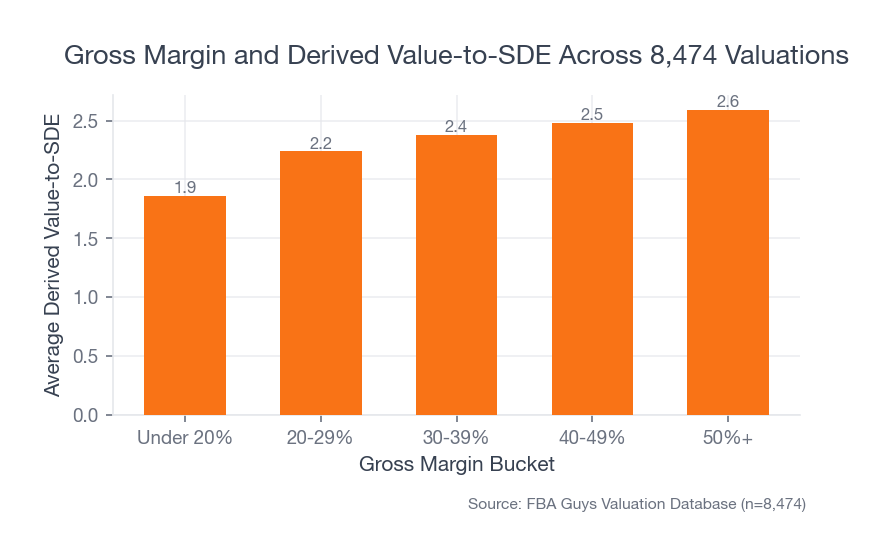
Among 8,474 successful valuation records where we could calculate a positive SDE proxy, the value-to-SDE proxy rose pretty steadily with gross margin. Under-20% gross margin businesses averaged 1.86. The 20-29% bucket averaged 2.24. The 30-39% bucket averaged 2.38. The 40-49% bucket averaged 2.48. At 50% and higher, the average reached 2.59.
 Source: FBA Guys Valuation Database (n=8,474)
That pattern isn't shocking, and perhaps that is why it is easy to skip past it.
What is useful is how directly it translates to return processing fees. A thin-margin SKU has fewer places to hide. If a product has modest gross margin, paid traffic dependence, and a return rate near the category threshold, the return processing fee doesn't need to be dramatic to change the product's contribution margin.
Contribution margin is the money left from a sale after the variable costs tied to that sale. In an FBA product, that means the revenue has to survive COGS, referral fee, fulfillment fee, ads, returns, return processing fee risk, and any resale loss from damaged or opened inventory.
There is a small indignity here. The product can look profitable in the catalog view and still fail in the return-adjusted view. We don't love that either.
But the math doesn't care, and your valuation certainly won't give the SKU credit for a margin that disappeared after the customer sent the unit back.
The operating expense pattern is less clean than you would expect
We also looked at operating expense as a percentage of sales. This produced a less tidy result, which is usually where the interesting part starts.
Businesses with operating expense under 5% of sales averaged 41.0% gross margin and a 2.42 value-to-SDE proxy. Businesses with operating expense above 20% of sales averaged 61.3% gross margin and a 2.44 value-to-SDE proxy.
The higher operating-expense group didn't collapse in value-to-SDE proxy because it also carried much higher gross margin. Of course, that doesn't mean high opex is free. It means you can't evaluate one line by itself and pretend you understand the business.
Return processing fees work the same way.
On one SKU, an extra return cost is a nuisance. On another, it is the last piece that makes the product's margin story stop making sense. A seller who tracks returns only at the account level is looking through frosted glass. You can see something moving. You can't see what it is.
Category matters, but don't overread it
Amazon's fee rules use category thresholds, so category obviously matters.
Our database isn't a return-rate database. It doesn't store returned-unit count, customer reason codes, product condition after return, or per-ASIN fee lines. That limitation is good to say plainly because this subject tempts people into fake precision.
Still, category proxies gave us one useful caution: category economics don't travel cleanly from the Amazon fee table into business value. That matters more than a category-by-category ranking here because return behavior is ASIN-level, while the valuation database category field is much broader.
The lesson isn't that one category is good and another is bad.
A category can have strong gross margin and still carry return behavior that needs close watching. A category can look operationally boring and produce excellent cash if the product survives returns cleanly.
One boring product with five years of steady reviews, predictable sizing, and few condition disputes may be more attractive than a prettier product with return reasons scattered across "not as described," "defective," "wrong size," and the classic customer note that reads like it was typed in a parking lot.
Messy detail, but that is where returns live.
SKU spread changes the risk
SKU count had a more interesting pattern than we expected.
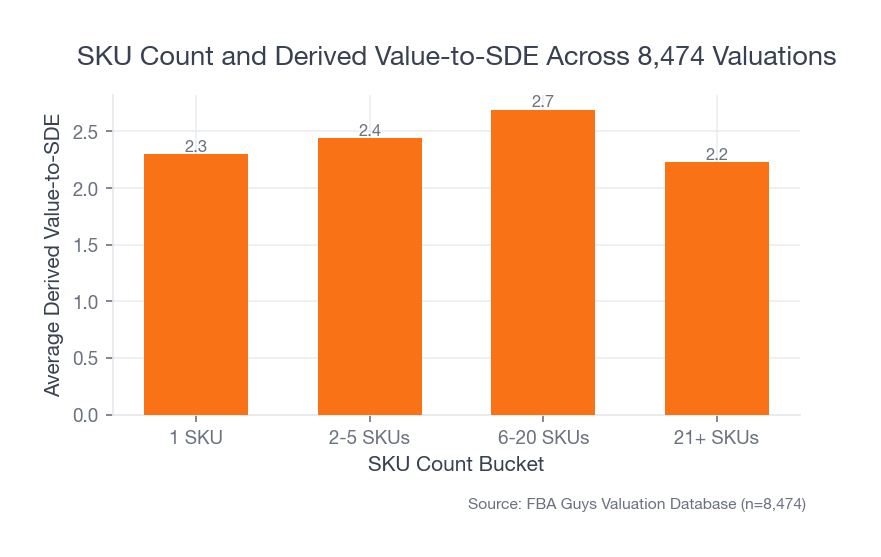
One-SKU businesses averaged a 2.30 value-to-SDE proxy. The 2-5 SKU group averaged 2.44. The 6-20 SKU group averaged 2.69. Then the 21+ SKU group dropped to 2.23, which is a nice reminder that diversification can help until it turns into a filing cabinet full of tiny mysteries.
 Source: FBA Guys Valuation Database (n=8,474)
That middle bucket is worth sitting with for a moment.
Six to 20 SKUs can be enough spread to keep one bad return profile from defining the whole account. It can also be small enough for the operator to know the products. Which ASIN gets opened and returned? Which variation creates sizing confusion? Which bundle gets damaged because the insert shifts in the box? Which product has a return rate that only looks acceptable because the high-volume winner is covering it?
At 21+ SKUs, the catalog can start hiding sins. Not always. Some operators manage broad catalogs beautifully. But blended reporting gets dangerous when return fees are charged at the product level and the operator is still thinking at the store level.
How to model the fee without making the spreadsheet silly
Start with the ASIN, not the account.
For each product that appears in Return Insights, build a return-adjusted contribution view:
- Selling price.
- COGS.
- Referral fee.
- FBA fulfillment fee.
- Advertising cost per unit sold.
- Expected return rate.
- Expected unsellable or discounted-return rate.
- Return processing fee exposure when the ASIN crosses the threshold.
Then run the model twice. First with the current return rate. Then with a stressed return rate that is a few points higher, because the SKU that survives only under a pleasant return assumption isn't quite as healthy as it looked in the first pass.
This is where the fee becomes useful. A return processing fee is annoying as a charge. As a diagnostic, it points to the ASINs where the product promise, packaging, sizing, image accuracy, or customer expectation may be leaking.
The fact is, a product with a high return rate is already trying to tell you something. Amazon just made part of the message easier to see in dollars.
What to do after you find the problem SKU
There are only a few productive responses.
Improve the listing if the return reason is expectation mismatch. Fix packaging if the returned item arrives damaged. Rework variation pages if size, color, bundle, or compatibility choices are creating confusion. Watch ad targeting if paid traffic is pulling in buyers who shouldn't have bought the product in the first place.
And yes, sometimes the answer is to let the SKU go.
That feels harsh until you compare it with carrying a product that eats margin, creates customer service drag, muddies the P&L, and still asks for inventory dollars every reorder cycle.
We tend to think of return processing fees as Amazon taking another bite. Fair enough. But in a valuation context, the more important question is whether the SKU would still be worth owning if Amazon never named the fee separately.
If return fees are showing up beside storage, placement, fulfillment, and ad costs, the broader read belongs in a full hidden FBA cost review, not just a fee-code cleanup.
FAQ
What is the Amazon return processing fee?
It is an FBA fee tied to processing returned products. As of 2026, Amazon applies an updated version to high-return-rate products outside apparel and shoes when returned units exceed the category threshold over the measured return window.
Where can sellers see whether a product is at risk?
Amazon points sellers to the FBA Returns page and Return Insights dashboard. That view shows returned units, return-rate percentages, thresholds, and returned units above the threshold.
Does the fee apply to every returned unit?
For the updated high-return-rate fee, Amazon says the fee applies when returned units exceed the category threshold. Products shipping fewer than 25 units in a month are exempt for that month under the announcement Amazon published for the 2024 update.
Should the fee make you discontinue a product?
Not by itself. A product deserves a full return-adjusted contribution view before you make that call. The fee is one input. The more useful question is whether the product still earns enough after returns, ads, fulfillment, resale loss, and replacement inventory.
Curious what your business is worth?
Get a free, instant valuation and see how your Amazon business stacks up.
Get Your Free Valuation