Amazon Small and Light Program Fees: The Program Is Gone, but the Low-Price Math Still Matters
The FBA Guys
May 14, 2026
The phrase "Amazon Small and Light program fees" still gets searched because sellers remember the old promise: small product, low price, lower fulfillment cost.
Amazon Small and Light program fees no longer apply in the US. Amazon closed FBA Small and Light on August 29, 2023 and replaced it with Low-Price FBA rates, which eligible low-priced items receive automatically. As of May 14, 2026, the useful question isn't how to enroll in Small and Light. The useful question is whether your cheap SKU still has enough margin after the current FBA fee stack, the 2026 fuel and logistics surcharge, storage, returns, and inventory cash.
That change sounds administrative.
It isn't.
Small and Light used to feel like a little side door for inexpensive products. Low-Price FBA moved that idea into the main rate card. Less enrollment friction is good. It also makes the math easier to ignore because there is no special program ceremony reminding you that the SKU sits on a narrow ledge.
We have a strange affection for cheap SKUs. They make ugly spreadsheets. A $0.22 packaging miss, a $0.17 surcharge, or a refund that lands two weeks after the sale can make the whole row look like somebody typed in the wrong margin. Honestly, that is the point. Low-price products don't forgive lazy unit economics.
Amazon Small and Light Program Fees Are Gone
Amazon's Selling Partner API announcement is the cleanest historical line. The US FBA Small and Light program closed on August 29, 2023, and Amazon replaced it with a Low-Price FBA fee rate card.
That matters because some older tutorials still talk about Small and Light as if you can enroll a SKU, wait for approval, and then manage a separate program track. In the US, that is stale advice. The old Small and Light API operations were deprecated, and Amazon told developers to discontinue Small and Light-related API use.
For sellers, the practical change is simpler: eligible low-priced FBA items are handled through current Low-Price FBA rates rather than a separate Small and Light enrollment workflow.
The name changed. The economic tension stayed.
You still have a product with a low selling price, Amazon handling fulfillment, and only a few dollars of room between revenue and regret. The fact is, a lower FBA rate helps only if the SKU was healthy before the discount.
What Replaced Amazon Small and Light Program Fees?
Low-Price FBA replaced the Small and Light structure.
Amazon's public FBA page now shows standard FBA fulfillment fees and separate Low-Price FBA fulfillment fees. As of May 14, 2026, Amazon lists Low-Price FBA rates below comparable standard FBA rates across small standard, large standard, bulky, and extra-large tiers. For example, non-apparel small standard Low-Price FBA rates run from $2.29 to $2.88 across the listed small-standard weight bands, while the comparable standard non-apparel small-standard rates run from $3.06 to $3.65.
Those differences are meaningful on a $7.99 item.
They are not magic.
Amazon also announced a 3.5% fuel and logistics-related surcharge that started April 17, 2026 for FBA in the US and Canada. Amazon said the surcharge is calculated on fulfillment fees, not the sale price, and averages $0.17 per unit for US FBA. On a premium product, $0.17 can disappear into the noise. On a low-price SKU, it starts asking questions.
Which questions?
Can the price absorb the fee? Can the conversion rate survive a price increase? Can the SKU keep Prime speed without turning inventory planning into a weekly fire drill? Can the product still fund ads, returns, storage, and replacement inventory?
The Revenue Calculator and Seller Central Fee Preview are the source of truth for the specific ASIN. Our FBA fulfillment fee breakdown can help with the basic structure, but the SKU-level preview tells you where the penny went.
How Low-Price FBA Fees Work Now
Low-Price FBA is best understood as a lower fulfillment-fee lane inside FBA for eligible low-priced items. If the dimensional weight side of the fee table is fuzzy, start with the Amazon FBA dimensional weight pricing explanation before trusting the rate card.
It doesn't remove referral fees. It doesn't remove storage. It doesn't remove inbound placement costs, return-processing exposure, prep costs, labeling costs, or the quiet cost of carrying too much inventory because the product is cheap enough to reorder without thinking.
That last one shows up constantly in fee conversations. A seller will fight for a lower fulfillment rate and then let the warehouse hold nine months of a slow-moving color variation because the reorder was only $3,400. Cheap inventory still uses cash. It still ages. It still has to be counted, reconciled, repriced, removed, or explained to a buyer later.
Here is a simplified way to read the fee:
- Start with the current selling price.
- Subtract referral fee and the current Low-Price FBA fulfillment fee.
- Add the current surcharge if applicable.
- Subtract product cost, freight-in, duty, prep, packaging, storage, returns, ads, and expected replacement inventory.
- Ask whether the remaining contribution margin is enough to fund the business, not just the next order.
The fifth step is where the small SKU stops being cute.
The Price Cutoff Can Turn Into Its Own Trap
Low-Price FBA creates a pricing cliff, and cliffs change behavior.
If a product sits just under the low-price threshold, the seller has an obvious temptation: keep the price under the line, preserve the lower fulfillment fee, and try to make the rest of the math work through volume. Sometimes that is exactly right. A product at $9.99 with strong conversion, low return exposure, and clean replenishment may be much healthier than the same product at $10.49 with weaker conversion and a higher fee.
But what if the SKU needs $10.49 to be honest?
That is where cheap products get uncomfortable. A seller can stare at a $9.99 price and treat the lower fee as proof the SKU belongs there. The fee table becomes a psychological anchor. Raising price feels like losing the benefit, even when the extra revenue would more than cover the higher fulfillment cost.
This is one of those places where the spreadsheet needs to be a little rude. Run both versions. If the item sells at $9.99, model the current Low-Price FBA fee, referral fee, surcharge, storage, ad spend, return allowance, product cost, and replenishment cash. Then run the same SKU at $10.49, $10.99, or whatever price the margin actually asks for.
Don't stop at fee savings. Ask what happens to contribution dollars per unit.
A lower fee on a lower price can still leave you with less cash per order. A higher fee on a higher price can still produce a better SKU if conversion holds well enough. Of course, conversion may not hold. That is why this can't stay theoretical; Seller Central gives you the current fee preview, and your own account gives you conversion, coupon, refund, and ad data.
The awkward part is that both answers can be true in the same catalog. One SKU should stay under the low-price line because the volume is clean and the margin survives. Another should move up in price because the old price only worked when freight, returns, and storage were behaving themselves. A third should probably be bundled, retired, or moved out of FBA entirely.
This is also where low-price products create a documentation problem. If you change price to preserve a fee tier, write down why. If you keep a SKU alive because it feeds a bundle or drives repeat orders, write that down too. Six months later, when the P&L has one line for Amazon fees and a dozen low-price SKUs all moving differently, you won't remember the logic as clearly as you think you will.
Nobody does.
The Fee Savings Only Matter If the Unit Economics Survive
Our valuation database doesn't store Amazon fee-line items, product prices, size tiers, or Low-Price FBA eligibility. That limitation is useful because it keeps us honest. We can't say, from the database, that Low-Price FBA caused a higher valuation.
We can look at the economic residue fee pressure leaves behind.
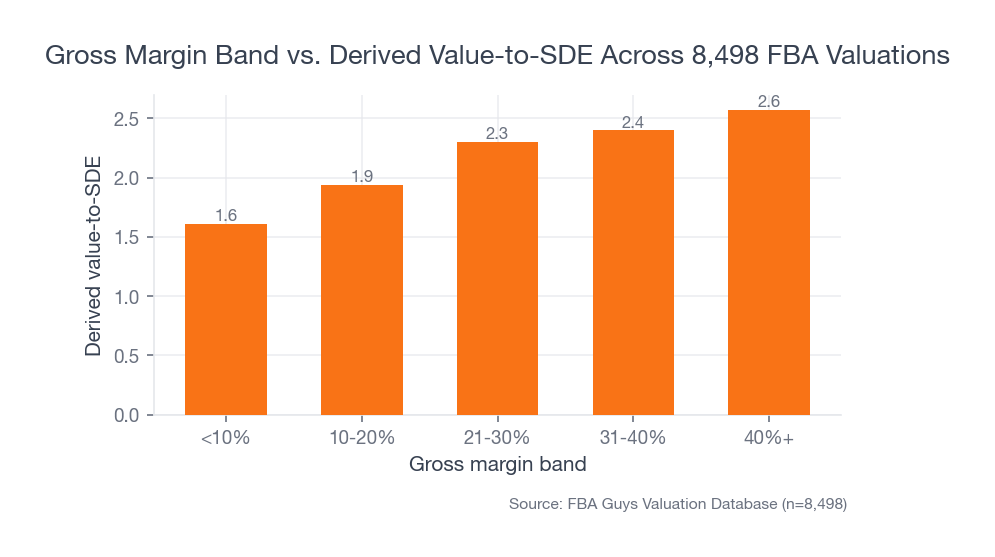
Across 8,498 usable valuation records, the under-10% gross margin group averaged 1.61 derived value-to-SDE across 157 records. The 10-20% band averaged 1.94 across 1,000 records. The 40%+ band averaged 2.57 across 4,328 records.
 Source: FBA Guys Valuation Database (n=8,498)
The jump from 10-20% to 21-30% matters more than the rate-card conversation usually admits. Low-Price FBA can protect a thin SKU from becoming unworkable, but the product still needs enough margin to survive the rest of the business.
What happens if a product sells for $9.99 and the fee savings preserve $0.77 of contribution margin?
That is worth having.
Now put that SKU next to a coupon, a return spike, a placement fee, and a restock order that arrives two weeks late because the factory closed for a holiday you remembered only after the purchase order was sent. The math gets less elegant. A tiny fee advantage can disappear into ordinary operating weather.
This is why the rate table should be treated as the first page of the analysis, not the last.
The Inventory Problem Cheap SKUs Create
Cheap SKUs invite casual inventory decisions.
The purchase order feels small. The cartons look manageable. The price point makes the product feel less dangerous than a $69.99 item with a heavier cash commitment. Then six months later, the business has twenty-seven little SKUs tying up cash in ways the P&L barely explains.
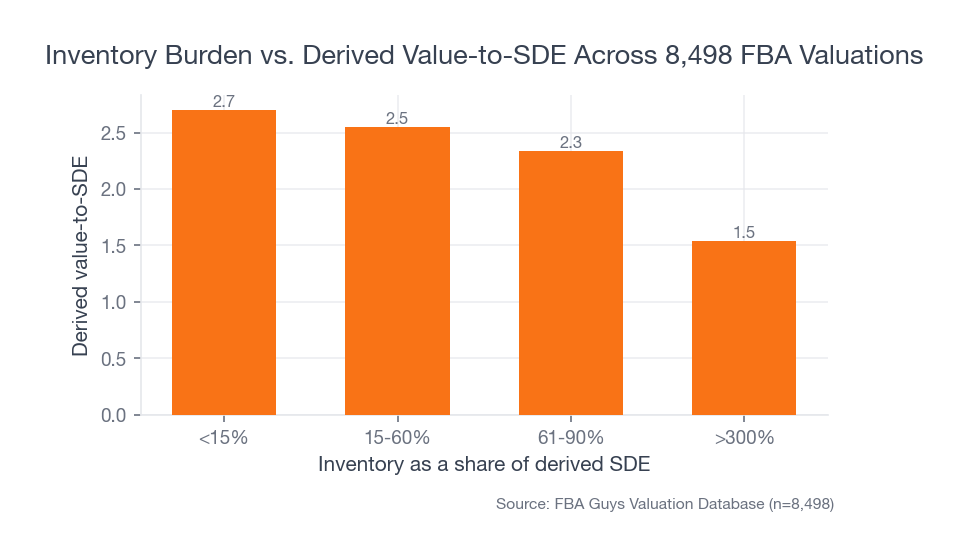
Our inventory-burden data is more blunt than the fee table. Businesses in the lightest inventory-to-SDE bucket, below 15%, averaged 2.70 derived value-to-SDE across 2,401 records. Businesses in the heaviest bucket, above 300%, averaged 1.53 across 1,418 records.
 Source: FBA Guys Valuation Database (n=8,498)
The reality is that inventory burden has a way of making a profitable SKU feel poorer than it looks.
That is especially true for low-price products because the seller often has to move a lot of units before the economics become interesting. More units means more forecasting. More forecasting means more ways to be wrong by a little bit every week.
There is another awkward piece here. Businesses that reported inventory turning every few months averaged 2.51 derived value-to-SDE across 4,185 records. Businesses turning every few weeks averaged 2.33. Businesses turning in a year or more averaged 2.06.
Faster did not win.
That surprised us less after looking at the surrounding data. The every-few-weeks group can include healthy velocity, but it can also include businesses that run close to the edge, reorder constantly, and create stockout risk if one shipment slips. The year-or-more group is the easier problem to see: stale inventory, too much cash sitting still, and a gross margin that may look better than the owner economics feel.
The better pattern is controlled replenishment. Enough stock to keep the SKU alive. Not so much that the business starts acting like a storage unit with a Seller Central login.
Where Low-Price FBA Helps
Low-Price FBA is most helpful when the SKU already has three things going for it:
- The product is genuinely small and cheap to fulfill.
- Gross margin remains healthy after all Amazon and operating costs.
- Replenishment is predictable enough that lower fulfillment fees don't get offset by stockouts or aged inventory.
That sounds basic because it is basic.
Basic is where a lot of money leaks out.
The best use case is a compact, repeatable product with stable demand, clean packaging, low return exposure, and enough margin that the Low-Price FBA rate improves an already working SKU. It is not a rescue plan for a product that needs Amazon to shave the fee just to make the contribution margin positive.
A small product can also be a useful catalog builder. It can bring repeat orders, support bundles, fill a brand line, or create a low-friction entry point for a buyer. Those are good reasons to keep one. The numbers still have to work without romance.
Where Low-Price FBA Flatters the SKU
Catalog breadth is where cheap products get slippery.
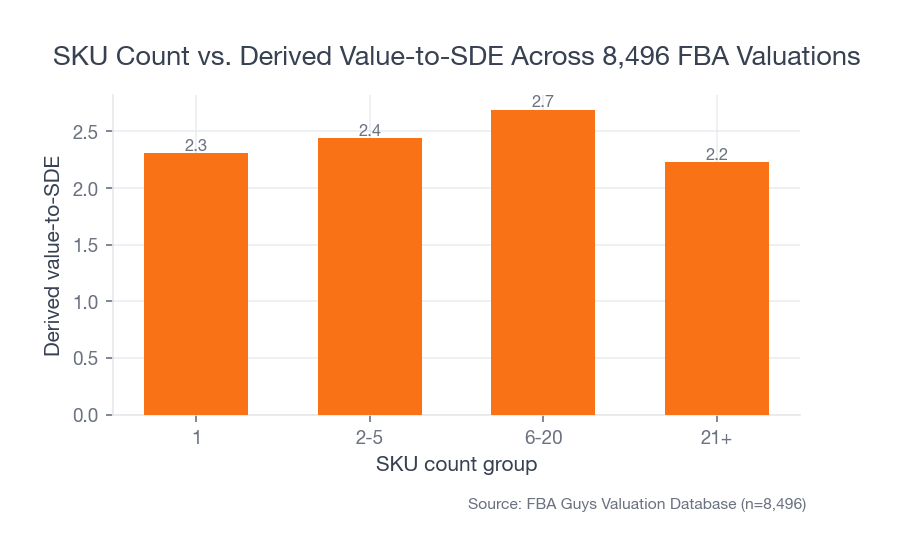
In our data, 1-SKU businesses averaged 2.31 derived value-to-SDE across 664 records. Businesses with 2-5 SKUs averaged 2.44. The 6-20 SKU group did best at 2.69 across 2,308 records. Then the 21+ SKU group fell to 2.23 across 3,890 records while carrying $248,416 in average inventory.
 Source: FBA Guys Valuation Database (n=8,498)
That middle range is interesting. It suggests buyers and valuation models can reward catalog diversity, but the reward fades when the catalog starts carrying too much operational weight.
Low-price products can push a seller past that line quietly. One variation turns into five. Five turns into fifteen. Suddenly each SKU has its own fee preview, inbound plan, return behavior, storage profile, coupon history, and reorder rhythm. None of those rows look fatal alone. Together, they become a management tax.
There is a reason the 21+ SKU group carries so much more average inventory. More SKUs need more bets placed in advance.
If those bets are disciplined, fine. If they are just cheap, the business starts collecting tiny problems at scale.
What This Means for FBA Business Value
Low-Price FBA is an operating tool. Business value still comes back to durable earnings, clean documentation, risk, growth, transferability, and inventory discipline.
A buyer or valuation model doesn't care that a SKU qualified for a lower fee in isolation. The useful question is what the lower fee did to owner earnings after the whole cost stack. Did it protect margin? Did it support stable velocity? Did it make the product easier to keep in stock without stuffing cash into inventory?
If yes, the old Small and Light idea still has life under its new name.
If no, the lower rate only made the product look viable for a little longer.
For a seller reviewing low-price SKUs, the practical work is simple and slightly tedious:
- Pull Fee Preview for each low-price ASIN.
- Recalculate contribution margin with current fulfillment fees and the 2026 surcharge.
- Separate storage, returns, ads, and inbound costs by SKU where possible.
- Rank low-price SKUs by contribution margin after inventory cash, not by unit sales.
- Remove, reprice, bundle, or stop replenishing products that need perfect conditions to work.
That list won't feel as satisfying as discovering a hidden fee program. It will probably make the spreadsheet uglier.
Good. The uglier spreadsheet is often the honest one.
There is also a timing habit here that matters more than it looks. Review low-priced SKUs after fee updates, after packaging changes, and after any meaningful price test. A product can pass the math in January and quietly fail it by June because storage, ads, returns, and replenishment each moved a little. None of those movements feel dramatic on their own. That is why they get missed.
For a cheap SKU, the review cadence should be boring enough to happen. Monthly is usually better than heroic. Pull SKU-level economics, compare the fee charged to the expected tier, check inventory position, and write down the price where the product stops making sense. The note can be three lines. It just needs to exist before the next repricer rule, coupon test, or supplier quote turns the old assumption into folklore.
FAQ
Does Amazon Small and Light still exist?
In the US, no. Amazon closed FBA Small and Light on August 29, 2023 and replaced it with Low-Price FBA rates. If an article tells you to enroll in Small and Light in the US, check the date before trusting the rest of the advice.
What replaced Amazon Small and Light program fees?
Low-Price FBA rates replaced the old Small and Light program structure. Eligible low-priced FBA items now use the Low-Price FBA rate card rather than a separate Small and Light enrollment track.
Are Low-Price FBA fees always better?
They are lower than the comparable standard FBA rates shown on Amazon's public FBA page as of May 14, 2026, but lower fees don't automatically make a SKU healthy. The product still has to survive referral fees, fulfillment, surcharge, storage, returns, ads, inventory cash, and product cost.
Should I price a product under $10 just to get Low-Price FBA treatment?
Run the SKU in Seller Central Fee Preview and the Revenue Calculator before changing price. Dropping price to chase a lower fulfillment fee can reduce contribution margin if the price cut is larger than the fee savings. The annoying answer is also the correct one: calculate the actual SKU.
How should I review old Small and Light SKUs now?
Start with the current fee preview, then rebuild contribution margin from scratch. Any SKU that works only because of one favorable fee line deserves a harder look. A low-price product should still produce cash after fulfillment, returns, storage, ads, and replenishment. For the broader cost review, use the same discipline we cover in how to reduce Amazon FBA fees.
Curious what your business is worth?
Get a free, instant valuation and see how your Amazon business stacks up.
Get Your Free Valuation