LLC vs S Corp for Amazon Sellers: The Tax Question Is Only Half the Problem
The FBA Guys
April 14, 2026

Amazon sellers usually arrive at the LLC vs S corp question at the wrong moment.
The business is finally throwing off real cash. Inventory is getting more expensive. Ad spend is no longer a line item you can ignore. The CPA mentions payroll, reasonable compensation, and distributions, and suddenly the seller is staring at their entity structure like it might be hiding money under the floorboards.
For most Amazon sellers, the LLC vs S corp decision is not really LLC versus corporation. It is usually an LLC taxed as a sole proprietorship or partnership versus an LLC electing S-corp tax treatment. The S-corp can reduce self-employment tax in the right situation, but it also adds payroll, stricter owner-compensation discipline, and more paperwork for buyers, lenders, and tax preparers to inspect later.
That last part gets skipped too often. We can see why. Nobody gets excited about entity hygiene. But when an FBA business is eventually valued, financed, or sold, the structure is only helpful if it made the numbers easier to trust.
What an LLC actually does for an Amazon seller
An LLC is a legal wrapper created under state law. It can separate the business from the owner, create a cleaner banking and contracting structure, and give the seller a more professional setup for Amazon, suppliers, lenders, and eventually buyers.
Tax treatment is a separate question.
The IRS business structures page makes this distinction plainly: your business structure affects which return you file, and an LLC is a state-law structure with tax treatment layered on top. A single-member LLC may be treated one way for federal tax purposes. A multi-member LLC may be treated another way. An LLC can also elect corporate tax treatment if it qualifies and files the right election.
That is where sellers start mixing up legal structure with tax election. The LLC is the container. The S-corp is usually the tax treatment.
For an Amazon seller still in the messy early stage, the LLC often gives enough structure without turning the owner into a payroll department. Open a separate business bank account. Keep Amazon payouts out of the personal checking account. Track inventory, ad spend, refunds, storage fees, reimbursements, and owner draws in a way a stranger could follow six months later.
That work sounds boring because it is. It also matters more than clever entity chatter.
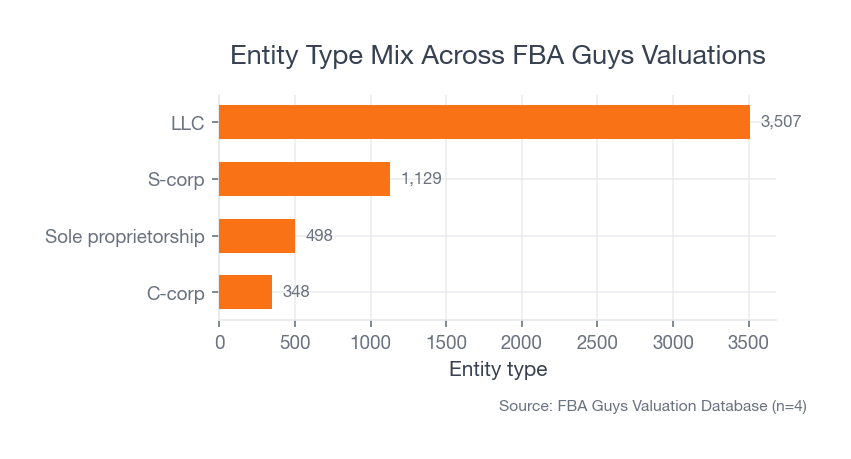
In our valuation database, LLCs are the most common structure by a wide margin. Among successful submissions with entity type populated, 3,507 were LLCs compared with 1,129 S-corps, 498 sole proprietorships, and 348 C-corps. That doesn't mean LLCs are better. It means they are the default path for many sellers, especially before the business becomes large enough to justify more administrative machinery.
 Source: FBA Guys Valuation Database (n=5,482)
What changes when an LLC elects S-corp tax treatment
An S-corp election changes how owner compensation is handled.
Instead of taking all business profit as pass-through owner income, a shareholder-employee who works in the business generally needs to receive reasonable wages through payroll before taking non-wage distributions. The IRS is direct on this point: S corporations must pay reasonable compensation to shareholder-employees for services they provide before non-wage distributions are made.
That is the trade. Some profit may move out as distributions instead of wages, which can reduce employment-tax exposure. But the seller now has to run payroll, file payroll tax forms, issue a W-2, handle state requirements, keep salary support, and avoid pretending that a person running purchasing, PPC, supplier calls, cash flow, and customer-service escalations somehow performed no meaningful services.
We ran this query three times because the raw valuation gap looks tempting.
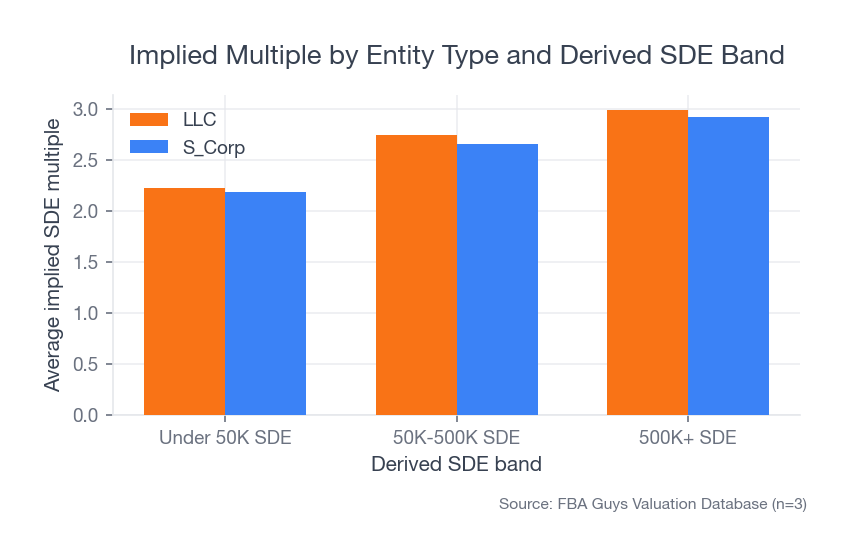
Average valuation in our database was about $1.34 million for LLCs and $2.42 million for S-corps. A lazy reading would say S-corps are worth more. That isn't what the data can support. S-corps in the database skew larger, older, and more administratively mature. Once we grouped LLCs and S-corps into broad derived-SDE bands, implied multiples were close: 2.22x vs 2.18x under $50K of derived SDE, 2.74x vs 2.66x in the middle band, and 2.99x vs 2.92x above $500K.
 Source: FBA Guys Valuation Database (n=4,636 LLC and S-corp submissions with positive derived SDE)
Entity election did not magically create value. Bigger, cleaner, more durable businesses were simply more likely to have grown into more formal tax planning.
Where the S-corp idea gets interesting
The S-corp discussion becomes serious when the business has enough consistent profit to make payroll costs, CPA work, state fees, and administrative time worth the trouble.
There isn't a universal revenue line where that happens. A seller doing $700,000 in revenue with thin margins, heavy ad spend, and volatile inventory buys may have less room than a seller doing half that with stable cash flow and disciplined books. If you're asking the question for your own account, the better version isn't "Am I big enough for an S-corp?" It is, "Is there enough repeatable profit after a reasonable owner salary to justify the complexity?"
That answer belongs with a CPA who understands e-commerce, inventory, marketplace payouts, and owner compensation. The difference between a clean S-corp and a sloppy one is not academic. It shows up as payroll entries, distributions, benefits, reimbursements, tax returns, and explanations.
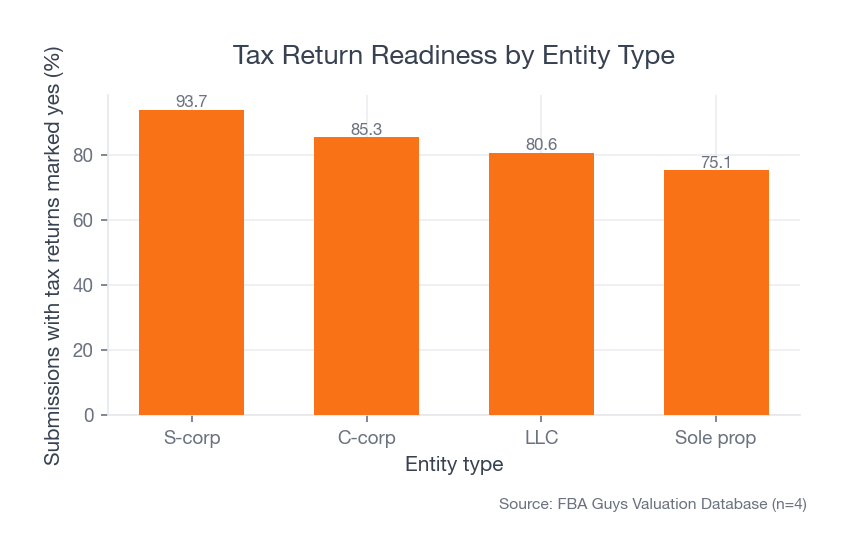
Here is the part sellers should care about from a future-sale perspective: S-corps in our database were much more likely to have tax returns marked as available. 93.7% of S-corps had tax returns marked yes, compared with 80.6% of LLCs and 75.1% of sole proprietorships.
 Source: FBA Guys Valuation Database (n=5,482)
That isn't proof that S-corps have better books. It is a clue about formality. S-corp treatment tends to bring a CPA deeper into the business because payroll, returns, owner compensation, benefits, and reimbursements all have to move through a system that leaves tracks. The structure nudges the seller into a more documented rhythm.
Or it should.
The part sellers make weird
The ugliest version of S-corp planning is the seller who hears "distributions aren't payroll taxes" and stops listening.
Now the owner takes tiny wages, pulls large distributions, runs personal expenses through the business because "the CPA will sort it out," and leaves a P&L full of owner decisions masquerading as operating reality. Then, two years later, the seller wants a valuation and acts offended when the first question is about compensation.
This is where the tax idea starts stepping on the sale conversation.
SDE, or Seller's Discretionary Earnings, is the profit metric buyers use for many owner-operated Amazon businesses. It starts with business earnings and adjusts for owner-specific, non-recurring, or discretionary expenses when those add-backs are documented. Owner salary can be part of that analysis. Payroll taxes can be part of that analysis. Personal expenses can be part of that analysis.
But "can be" is doing a lot of work.
A buyer can accept a clean owner-compensation adjustment when the records make sense. They are less excited about rebuilding two years of payroll, distributions, home-office reimbursements, Amazon purchases, and owner credit-card charges from screenshots and apologies. Nobody wants to diligence a business by reading the owner's Venmo history in spirit, even if the bank statements are technically PDFs.
What buyers and lenders care about later
Buyers usually don't start with entity type. They start with trust.
Can the numbers be verified? Are the tax returns available? Does the Amazon seller P&L reconcile to bank deposits and Amazon settlement activity? Are owner expenses separated clearly enough that add-backs can be defended? If the seller says the business produces $280,000 of SDE, can a buyer follow the path from Amazon revenue to gross margin to operating expense to owner benefit without needing a whiteboard and a forgiving mood?
The entity matters when it affects those answers.
An LLC with separated accounts, clean accrual books, monthly inventory discipline, and complete tax returns can look better than an S-corp with clever tax planning and muddy records. Our data supports that caution. LLCs were actually more likely than S-corps to report separated business finances in the comingle proxy: 83.7% for LLCs versus 76.6% for S-corps.
So no, S-corp status isn't a shortcut to legitimacy. It is a structure that can support legitimacy if the operator does the work.
For SBA-backed buyers, lenders often care deeply about tax returns and owner compensation because they need to underwrite cash flow. For strategic buyers, the entity may matter less than whether the assets transfer cleanly and whether the earnings story survives diligence. For the seller, the sale itself may be structured as an asset sale or something else depending on the deal, tax facts, and legal advice.
That is why this decision should be made before the business is under pressure. Entity cleanup during a sale feels like changing lanes while towing a trailer. Technically possible. Still not a hobby.
When staying an LLC is probably cleaner
Staying with default LLC tax treatment may be cleaner when the business is early, profit is inconsistent, the owner is still reinvesting heavily into inventory, or the seller does not have the bookkeeping discipline to support payroll and distributions properly.
That last one sounds harsh. Good. It should.
If the books are already messy, an S-corp election adds more surfaces for mistakes. Payroll has deadlines. Reasonable compensation needs support. Benefits have rules. State filings vary. Distributions need to be tracked. Owner loans need to be real loans, not vibes with a balance sheet attached.
The better sequence is usually: separate the money, clean the P&L, track inventory properly, understand true SDE, then decide whether S-corp treatment makes sense with a CPA. Amazon FBA accounting basics covers that foundation in more detail. Sellers want the tax move to create discipline. Discipline should come first.
A practical decision frame
Use this as a conversation starter with your CPA, not as a substitute for one, because the right answer depends on your state, your profit pattern, your role in the business, your payroll setup, and how much administrative work you're actually willing to maintain after the election is made.
First, confirm what you have. Are you a sole proprietor, single-member LLC, partnership, corporation, or LLC already taxed as an S-corp? Many sellers are fuzzy on this. The IRS and your state may be looking at different parts of the structure.
Second, estimate steady owner earnings after real business expenses. Don't use your best month and don't use revenue, because neither one tells you whether the business has enough repeatable profit after COGS, Amazon fees, ad spend, software, contractors, returns, storage, freight, and the expenses that keep the machine running. If state obligations are also part of the cleanup, this Amazon FBA tax obligations by state guide separates marketplace collection from seller filing and documentation work.
Third, ask what a reasonable salary would look like for the work you actually perform. If the business depends on you to manage suppliers, product launches, PPC, cash flow, and account health, the answer won't be zero. The IRS has been clear that shareholder-employees who provide services can't simply relabel wages as distributions.
Fourth, price the hassle honestly. Payroll service, CPA fees, state filings, extra bookkeeping time, and owner-compensation support all have a cost. If the estimated tax savings barely covers that cost, the business may be buying complexity for sport.
Fifth, think about the future buyer. Will this structure make diligence cleaner or noisier? Will a lender understand the returns? Will the add-backs be easier to defend? Will the payroll and distributions tell a coherent story?
That is the real test.
FAQ
Should Amazon sellers use an LLC or an S-corp?
Many Amazon sellers start with an LLC because it creates a legal business structure without immediately adding S-corp payroll requirements. S-corp tax treatment may make sense later when profit is consistent enough to justify reasonable compensation, payroll filings, CPA involvement, and the administrative load. The right answer depends on the seller's profit, state, owner role, and tax situation.
Does an S-corp reduce Amazon seller taxes?
It can reduce employment-tax exposure in some cases because some profit may be distributed outside payroll after reasonable owner wages are paid. That is general tax mechanics, not a guarantee. The tax savings can disappear quickly if profit is too low, salary support is weak, state costs are high, or compliance work gets sloppy.
Does an S-corp make an Amazon FBA business worth more?
Not by itself. In our database, S-corps had higher raw average valuations, but they also skewed larger. Inside rough SDE bands, LLC and S-corp implied multiples were close. Buyers care more about earnings quality, documentation, transferability, risk, and growth than the label on the entity.
Can an LLC elect S-corp taxation?
Yes, an eligible LLC can generally elect to be taxed as an S-corporation for federal tax purposes by filing the proper election. The LLC remains an LLC under state law while changing its federal tax treatment. Sellers should handle that with a CPA because timing, eligibility, payroll, state treatment, and reasonable compensation all matter.
What should sellers fix before changing tax treatment?
Separate accounts, clean monthly books, inventory tracking, accurate P&Ls, tax-return readiness, and owner-expense discipline. If those are weak, the S-corp election may add paperwork before it adds clarity.
The entity should make the business easier to explain.
If it makes the tax return clever and the diligence file worse, that isn't sophistication. That is a mess with a filing deadline.
Curious what your business is worth?
Get a free, instant valuation and see how your Amazon business stacks up.
Get Your Free Valuation