Amazon FBA Air vs Sea Shipping Cost: The Faster Route Has to Pay for Itself
The FBA Guys
June 15, 2026

The first quote is rarely the real comparison.
Air usually costs more and arrives faster. Sea usually costs less per unit and asks you to plan earlier. For Amazon FBA air vs sea shipping cost, the practical answer is to compare landed cost per sellable unit, the days of inventory each mode protects, the gross profit saved by avoiding a stockout, and the cash tied up while inventory is in transit or sitting on the shelf.
That is where the decision gets useful. Air freight buys time. Sea freight buys lower freight cost per unit. SKU economics decide which one the business can afford.
How to Compare Amazon FBA Air vs Sea Shipping Cost
Compare the two modes with the same destination, same supplier pickup point, same customs assumptions, same Amazon receiving path, and the same unit count.
The basic formula is:
- Start with product cost.
- Add freight, insurance, duties, tariffs, customs broker fees, destination charges, prep, labels, pallets, and Amazon inbound costs where applicable.
- Divide by sellable units received.
- Compare the remaining gross profit per unit.
- Add the inventory timing question: how many days does each route protect or expose?
That last step is where most quote comparisons become too narrow. A sea shipment can look much cheaper per unit and still be expensive if it creates a stockout. An air shipment can look reckless and still be rational if it protects a profitable launch or keeps a high-velocity SKU in stock.
For imports, Trade.gov's tariff guidance is a useful reminder that duty estimates start with product classification, and actual tariff rates are determined by customs. The freight quote doesn't answer that part for you unless the quote clearly includes it and shows the assumptions.
What Air Freight Buys
Air freight buys speed and smaller replenishment decisions.
That can matter when a listing is about to stock out, when a launch needs a small first batch, when a seasonal window is closing, or when the next sea shipment is already booked but late. The higher freight cost is easier to defend when the shipment is small, the SKU has strong margin, and the lost sales would be more expensive than the speed premium.
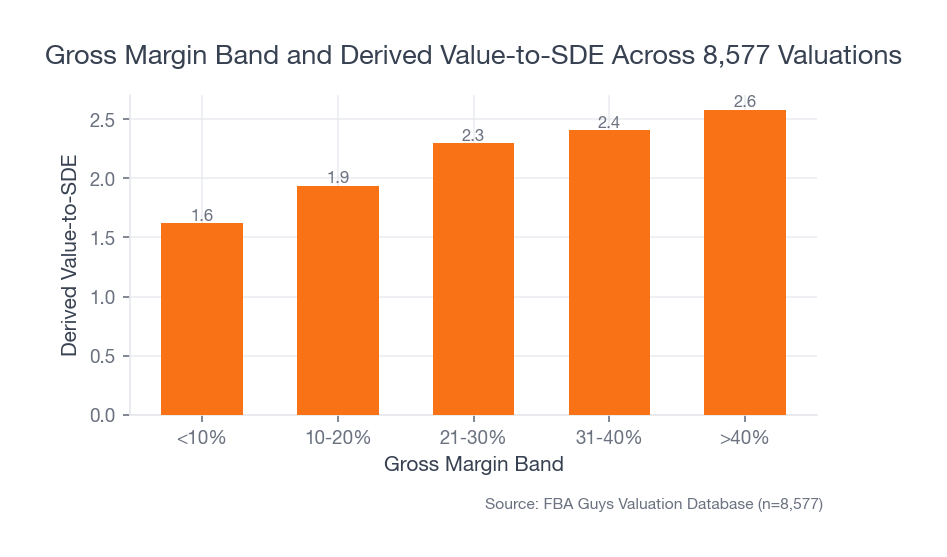
Margin is the first test. In the FBA Guys database, the >40% margin bucket averaged 2.58 derived value-to-SDE across 4,378 records. The 10-20% bucket averaged 1.94 across 1,006 records, and the under 10% bucket averaged 1.62 across 158 records.
 Source: FBA Guys Valuation Database (n=8,577)
The database doesn't say high-margin SKUs should use air freight. It says margin changes the amount of error a business can absorb. A $4 per-unit freight premium behaves differently on a product with $22 of contribution margin than it does on a product with $6.
Air freight is worth testing when you can answer four questions:
- How many selling days does air save?
- How many units would sell during those days?
- What gross profit remains after the air premium?
- What happens to rank, ads, reviews, or launch timing if the SKU stocks out?
If those answers are specific, air freight becomes a controlled decision. If they are guesses, air becomes a reaction to a reorder calendar that already failed.
What Sea Freight Requires
Sea freight requires time, cash, and tolerance for variability.
It often wins on freight cost per unit, especially when the order is large enough for container economics or a well-priced less-than-container-load route. Amazon Global Logistics publicly describes ocean and air freight options, FCL and LCL, Seller Central booking and tracking, customs clearance, and delivery to FBA or AWD. That makes ocean easy to quote for eligible routes, but the lower freight line still has to survive the inventory math.
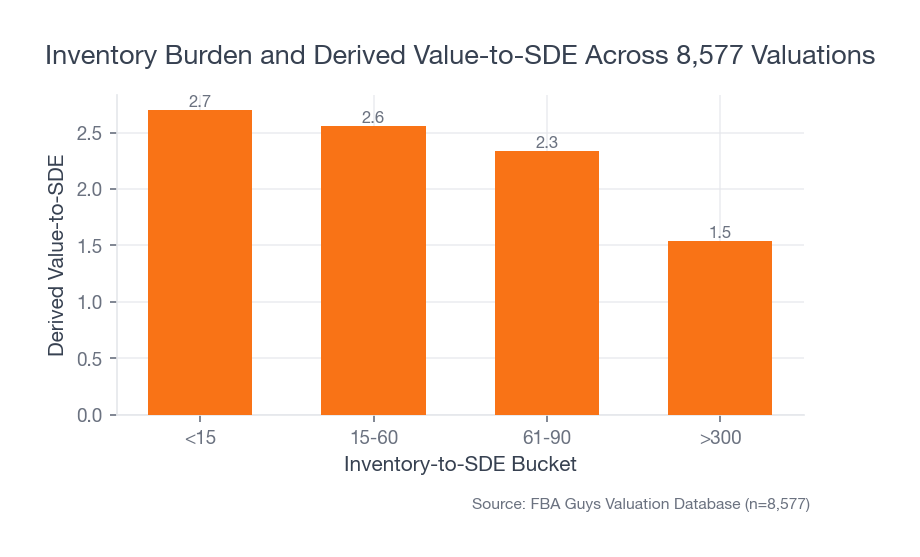
The strongest adjacent data point is inventory burden. Among 8,577 qualifying records in the FBA Guys database, the lightest inventory-to-SDE bucket averaged 2.70 derived value-to-SDE, 57.1% margin, and $45,662 average inventory. The heaviest bucket averaged 1.54 derived value-to-SDE, 34.7% margin, and $305,034 average inventory.
 Source: FBA Guys Valuation Database (n=8,577)
We don't know whether sea freight caused those heavy inventory positions. The database doesn't store freight mode. The useful reading is narrower: inventory cash isn't a side issue. It sits close to the economics that show up in valuation context.
Sea freight can be the right route and still create a cash problem. A seller may need to order earlier, carry more safety stock, finance a larger MOQ, or hold inventory longer before the revenue comes back. Our Amazon FBA minimum order quantity negotiation guide covers the same cash exposure from the supplier side.
The Stockout Calculation
The other side of heavy inventory is too little inventory.
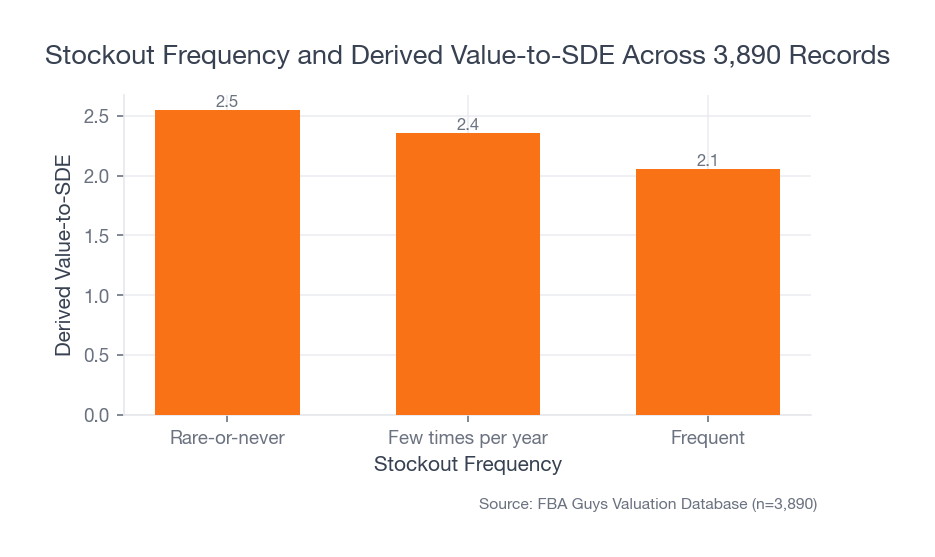
Rare-or-never stockout records averaged 2.55 derived value-to-SDE across 2,829 records. Few-times-per-year records averaged 2.36 across 754 records. Frequent-stockout records averaged 2.06 across 307 records.
 Source: FBA Guys Valuation Database (n=3,890)
That doesn't prove air freight creates value. It does show why speed deserves a real calculation. If a SKU is genuinely going to stock out, the air premium should be compared with the gross profit and operating damage avoided during the days saved.
Use a simple stockout cost estimate:
- Daily units sold.
- Gross profit per unit after normal landed cost.
- Days saved by air versus sea.
- Expected receiving delay after arrival.
- Any launch, seasonal, or advertising risk that depends on staying in stock.
Then compare that number with the air premium. If air costs $3,000 more but protects $9,000 of contribution margin, it may be cheap. If it protects $1,200, the faster route probably needs a different reason.
The math won't be perfect. Amazon receiving time, demand, and ad performance all move. But an imperfect estimate is better than treating the air quote as expensive in isolation.
Freight Rates Need a Date Stamp
Static rate rules age badly.
Freightos reported in its June 12, 2026 weekly update that Asia-US West Coast weekly ocean prices increased 51%, Asia-US East Coast prices increased 25%, and China-North America air prices decreased 1%. That update isn't a rate card for your shipment. It is a reminder that the spread between air and sea can change quickly.
The Baltic Exchange describes its air freight indices as weekly transactional-rate indices for general cargo. That is useful market context. Your actual quote still depends on route, weight, volume, cargo type, ship date, carrier capacity, service level, and what is included after arrival.
So compare quotes as of the booking date. Keep the quote PDF or email. Keep the assumptions. When the landed cost changes later, you want to know whether freight mode, freight market, duty, pack setup, Amazon routing, or supplier terms moved the number.
What Belongs in Landed Cost
Landed cost is the number to compare because it follows the unit into the business.
For an FBA import, landed cost usually includes:
- Product cost.
- Origin pickup or supplier delivery charge.
- Air or sea freight.
- Insurance.
- Duties, tariffs, and customs fees.
- Customs broker or forwarder fees.
- Destination handling, drayage, or final delivery.
- Prep, labels, pallet work, and carton changes.
- Amazon inbound placement or routing costs where applicable.
- Units lost, damaged, rejected, or not sellable.
This is why supplier-included shipping needs a closer look. A bundled quote may be fine, but it should still identify who is the importer of record, what Incoterms apply, how duties are handled, which documents you receive, whether delivery to Amazon is included, and what happens if Amazon changes the receiving plan.
If the quote hides those inputs, the cost may be convenient rather than clear. Our Amazon FBA freight forwarding explained guide covers the handoffs that tend to sit behind that one line item.
A Practical Air vs Sea Rule
Use sea freight for planned replenishment when the reorder calendar is honest, the business has enough coverage, and the lower landed cost improves margin without trapping too much cash in inventory.
Use air freight for small, specific problems: launch inventory, emergency top-ups, high-margin SKUs, seasonal timing, or a bridge shipment while the main sea order is moving.
The cleanest setup is often a split shipment. Send enough by air to protect the listing, then send the main quantity by sea. That does two things: it limits the air premium and keeps the slower, cheaper route from carrying the whole stockout risk.
The split only works if the numbers are explicit. You need daily sales velocity, days of coverage, lead time by mode, landed cost by mode, gross profit by mode, and the cash required for each purchase order. Our Amazon FBA inventory management best practices guide is the better place for the reorder mechanics.
What the FBA Guys Data Can and Can't Tell Us
The database helps define the decision. It doesn't name the winner.
We can see that inventory burden matters. We can see that stockout frequency matters. We can see that margin bands matter. We can see inventory turnaround and supplier-location patterns.
We can't see air freight, sea freight, LCL, FCL, Incoterms, forwarder name, freight spend, customs broker, port delay, Amazon receiving delay, or Amazon Global Logistics usage. So the honest conclusion is limited: air vs sea shipping cost should be evaluated through the variables that affect the business directly, especially margin, stockouts, and inventory cash.
That limit matters. It keeps the article from pretending that one freight mode is always smarter.
FAQ
Is air freight or sea freight cheaper for Amazon FBA?
Sea freight is usually cheaper per unit for planned, larger shipments. Air freight is usually more expensive, but it arrives faster and can make sense for launches, urgent replenishment, high-margin SKUs, or stockout prevention. Compare landed cost and stockout risk, not only freight price.
Should I ever use both air and sea for the same reorder?
Yes, a split shipment can work well. Send a small quantity by air to protect the listing, then send the main order by sea. The air quantity should be based on expected daily sales and the number of days the sea shipment will arrive after stock runs out.
Does Amazon Global Logistics handle air and sea freight?
Amazon Global Logistics publicly describes ocean and air freight options for eligible routes. That includes FCL, LCL, Seller Central booking and tracking, customs clearance, and delivery to FBA or AWD. It should still be compared against third-party forwarders and supplier-arranged shipping on total landed cost and service scope.
What is the biggest mistake in comparing air vs sea shipping?
The biggest mistake is comparing freight quotes without converting them into landed cost per sellable unit and days of inventory coverage. The cheaper quote can become expensive if it causes a stockout or forces the business to carry more inventory than its cash flow can support.
Conclusion
Amazon FBA air vs sea shipping cost is a speed and cash decision.
Air buys time. Sea buys lower per-unit freight cost. The better route is the one that leaves enough margin after landed cost, protects the SKU from avoidable stockouts, and doesn't push too much cash into inventory.
The FBA Guys data points toward that operating band. The lightest inventory-to-SDE bucket averaged 2.70 derived value-to-SDE, while the heaviest bucket averaged 1.54. Rare-or-never stockout records averaged 2.55, while frequent-stockout records averaged 2.06.
Those numbers don't choose air or sea for you. They tell you what the choice has to protect: margin, availability, and cash.
Curious what your business is worth?
Get a free, instant valuation and see how your Amazon business stacks up.
Get Your Free Valuation