Amazon FBA Freight Forwarding Explained: The Quote Is Only One Part of the Cost
The FBA Guys
June 14, 2026

Freight forwarding starts to look simple right up until your inventory has to move through a supplier, a truck, a port or airport, a customs entry, another truck, and an Amazon receiving path that may change after you created the shipment.
If you are looking for Amazon FBA freight forwarding explained, the clean definition is this: an FBA freight forwarder coordinates the movement of your inventory from the supplier or origin warehouse to the place where Amazon can receive it. For an imported shipment, that can include origin pickup, export paperwork, ocean or air freight, customs handoff, destination transport, appointment coordination, and final delivery into FBA, AWD, or a staging warehouse.
The better question is what the forwarder does to your landed cost and inventory timing. That is where the shipping decision starts to affect margin, cash flow, and the records someone else will need if they ever have to operate or value the business.
What Does an Amazon FBA Freight Forwarder Do?
An Amazon FBA freight forwarder manages the handoffs between your supplier and Amazon's fulfillment network.
That usually means the forwarder or its partners coordinate some combination of factory pickup, export documents, container or air cargo booking, customs brokerage, destination delivery, and Amazon delivery appointment work. The exact scope depends on the shipment, the forwarder, the country, the freight mode, and whether inventory is going straight to FBA, into Amazon Warehousing and Distribution, or to a 3PL first.
FBA stands for Fulfillment by Amazon. Amazon stores the inventory, ships customer orders, handles many customer-service tasks, and processes returns. The freight forwarder sits before that system. Its job is to get the inventory into the receiving path correctly enough that FBA can do its job.
The forwarder doesn't remove your responsibility for the shipment. It gives you one accountable process for a set of tasks that are easy to underestimate until a customs question, carton-label issue, or delivery appointment problem appears.
Where the Handoffs Usually Happen
For a typical import into the United States, the handoffs often look like this:
- The supplier finishes production and prepares cartons.
- The shipment is picked up at the factory or origin warehouse.
- Export paperwork is prepared in the origin country.
- Cargo moves by ocean, air, or another freight path.
- The shipment clears customs at destination.
- The goods move to Amazon, AWD, or a 3PL.
- Amazon receives inventory against the shipment plan.
Each handoff can create a cost or a delay: a carton count is wrong, the packing list conflicts with the commercial invoice, customs requests a review, the container waits at port, the truck misses an appointment, or Amazon routes inventory into multiple destinations.
The forwarder's value is partly freight price. It is also whether those handoffs are visible before they become inventory problems.
Can Your Supplier Ship Straight to Amazon?
Sometimes your supplier can arrange shipping directly to Amazon. That may be fine for a small reorder or a supplier you know well.
The test is visibility. You still need to know who is the importer of record, how duties and taxes are being handled, what Incoterms apply, whether the carton and pallet setup matches Amazon's current receiving requirements, and whether the quote includes every charge needed to get the inventory into the Amazon network.
Supplier-arranged shipping can hide the freight math inside one bundled number. That is convenient when everything goes right. It is less helpful when you are trying to understand why the landed cost changed or why a shipment sat for a week in a place no one named clearly on the quote.
For a repeatable product, we would rather see the freight path become part of the operating file. The route, documents, contacts, cost build-up, and exceptions should be clear enough that someone else can run the next reorder without reconstructing the process from email threads.
Amazon Global Logistics vs. a Third-Party Forwarder
Amazon Global Logistics is Amazon's cross-border freight option for eligible FBA sellers. Amazon's public program page describes ocean and air freight from China into the Amazon fulfillment network in several marketplaces, plus ocean freight from Vietnam to the US. It also describes services such as origin pickup, export declaration, cross-border transportation, customs clearance, delivery to FBA or AWD, FCL, LCL, and air freight.
That makes Amazon Global Logistics a real option to quote. It doesn't make it the only option.
A third-party forwarder may be a better fit when you need a specific port strategy, non-Amazon storage, multi-channel routing, unusual prep, several destination warehouses, or a customs broker relationship outside Amazon's workflow. Amazon Global Logistics may be attractive when the shipment is headed straight into Amazon's network and you want the booking workflow, tracking status, and placement to sit closer to Seller Central.
Our read: quote both when the shipment is large enough to matter. Compare the full landed cost and the operating fit, not only the ocean rate.
Ocean, Air, LCL, and FCL
The freight mode decision starts with timing and cash.
Air freight is usually the rescue or launch tool. Amazon Global Logistics describes air freight as a faster option into the Amazon network, with a 7-10 day entry window on its public program page. That speed can protect a listing when you are short on inventory, but the cost has to survive the product's margin.
Ocean freight is usually the planned-reorder tool. Full container load can work when you have enough volume to use the container well. Less-than-container load can work when you need to move a smaller quantity without waiting to fill a container. LCL often adds consolidation and handling steps, so the lower volume commitment can come with more handoff risk.
The mode decision becomes clearer when you run it through the reorder math:
- How many days until the SKU stocks out at current velocity?
- How much margin disappears if you use the faster freight option?
- How much revenue disappears if you wait for the slower option?
- How much extra inventory will you carry if you order enough to justify a larger shipment?
- Can the business fund that inventory without starving ads, product development, or the next purchase order?
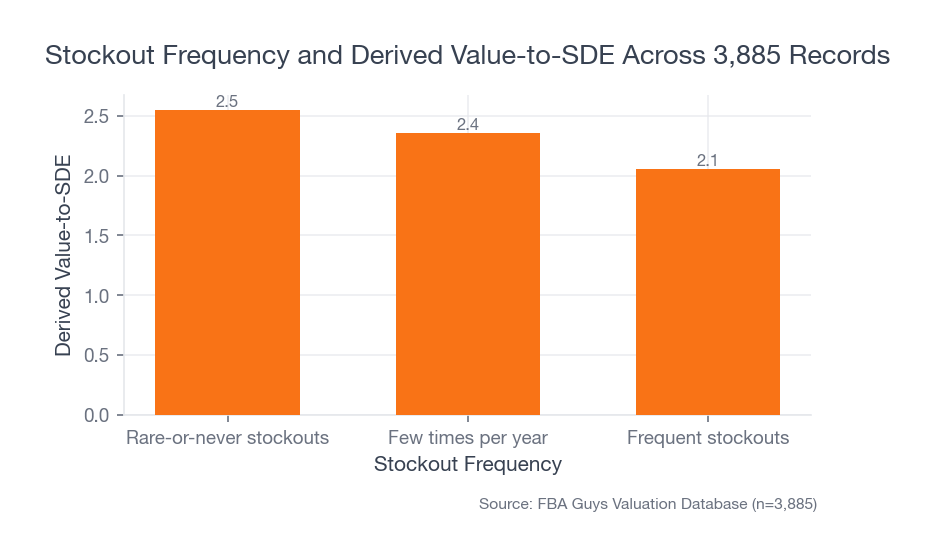
The FBA Guys database can't tell us whether air or ocean produces a higher valuation. It can tell us that inventory timing sits close to value. Among records with stockout data and positive derived SDE, rare-or-never stockout businesses averaged 2.55 derived value-to-SDE. Frequent-stockout businesses averaged 2.06.
That doesn't mean you should pay for air freight every time inventory gets tight. It means the stockout risk belongs in the same calculation as the freight rate.
The Cost to Compare Is Landed Cost
Landed cost is the total cost to get sellable inventory into the place where it can be sold or fulfilled. For an FBA seller, that usually starts with product cost and then adds freight, duties, tariffs, customs broker fees, insurance, pickup or drayage, destination charges, prep work, labels, pallets, and any other cost needed before the inventory is ready for Amazon's receiving path.
The product cost alone can make a reorder look better than it is. A supplier quote may show a clean unit price while the actual landed cost changes because freight, duty, inbound placement, prep, or storage changed.
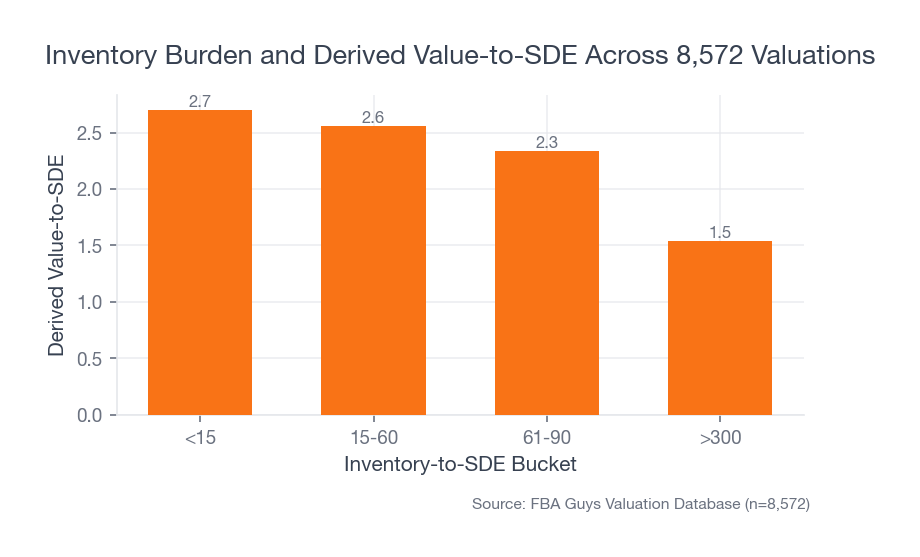
This is where freight forwarding becomes a valuation topic. In the FBA Guys database, inventory burden is the strongest adjacent signal for this subject. Records in the lightest inventory-to-SDE bucket averaged 2.70 derived value-to-SDE. Records in the heaviest bucket averaged 1.54. The heavy bucket also carried much lower average margin, 34.7% compared with 57.1% in the lightest bucket.
 Source: FBA Guys Valuation Database (n=8,572)
The database doesn't prove freight choices caused that difference. It does show the shape of the problem. If a cheaper shipping plan forces you to carry too much inventory, the cost didn't disappear. It moved from the freight quote into working capital.
The accounting treatment matters as well. If freight for four months of inventory is expensed in the wrong month, the P&L can make one month look worse and another look better. For valuation work, freight belongs in the inventory cost picture because it affects both margin and the dollar value of sellable inventory on hand.
Freight Decisions Show Up in Inventory Timing
Freight changes the reorder point because it changes lead time, variability, and cash exposure.
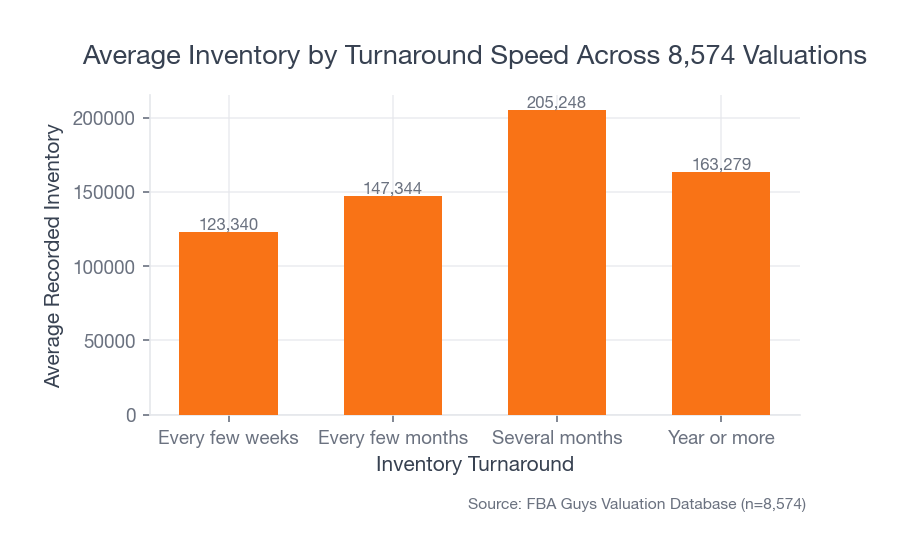
Among 8,574 successful valuations, 31.6% of records with inventory-turnaround data turned inventory every few weeks, 49.3% turned every few months, 15.9% took several months, and 3.2% took a year or more. Average recorded inventory was $123,340 for every-few-weeks businesses, $147,344 for every-few-months businesses, $205,248 for several-month businesses, and $163,279 for year-or-more businesses. Our Amazon FBA inventory management best practices guide covers the reorder side of that same problem.
 Source: FBA Guys Valuation Database (n=8,574)
The several-month group is the one that kept pulling our attention. It carried the highest average inventory load, but not the highest average sales or valuation. That is the freight-forwarding issue in a more useful form: a slower or bulkier route may reduce per-unit freight cost while making the business carry more cash in transit and on hand.
The other side is stockouts. Rare-or-never stockout records averaged 2.55 derived value-to-SDE. Few-times-per-year stockout records averaged 2.36. Frequent-stockout records averaged 2.06.
 Source: FBA Guys Valuation Database (n=3,885)
So the practical question isn't simply "How do I ship cheaper?" It is "Which freight plan keeps the SKU in stock without forcing the business to carry more inventory than the margin can support?"
That is the operating band. Too little inventory and the listing loses sales history. Too much inventory and the business can look profitable while cash is trapped in boxes.
Customs and Importer-of-Record Responsibility
For US imports, an importer of record is usually required. CBP guidance for importers also says that even when a broker is used, the importer of record is ultimately responsible for the correctness of entry documentation.
That means the forwarder or customs broker can help prepare and file the shipment, but customs shouldn't become an invisible task. You need to know who the importer of record is, what importer number or tax ID is being used, whether a customs bond is required, how classification and valuation are supported, and how duties are paid. For tariff math, keep the calculation separate from the freight quote; our Amazon FBA duty and tariff calculator explains that layer.
This is a good place for boring records: commercial invoice, packing list, HTS/classification support, customs entry records, duty payment records, and forwarder or broker correspondence.
If you are using supplier-arranged freight, this section deserves extra attention. Ask directly who appears as importer of record and what documents you will receive after clearance.
The Reorder File Matters More Than Memory
The freight-forwarding file should let someone else understand the route, the cost, and the next reorder.
At minimum, keep the purchase order and supplier invoice, plus the commercial invoice, packing list, quote, booking confirmation, bill of lading or air waybill, customs entry summary, duty/tariff record, insurance record if applicable, Amazon shipment IDs, carton labels, pallet details, receiving discrepancies, and the landed-cost calculation used in your books.
The file should also explain who does what: supplier contact, forwarder contact, customs broker, importer of record, payment terms, pickup location, destination path, required labels, and backup route.
This connects to transferability. A buyer, lender, new operator, or future employee doesn't need your memory if the route, math, and documents are already clear.
Backup Vendors Need Backup Routes
The supplier data gives us useful context, with the same causation limit as the rest of this article.
Records with backup vendors averaged $1,611,802 in valuation across 4,986 valuations. Records without backup vendors averaged $810,645 across 3,588 valuations. For one-supplier businesses, records without backup vendors averaged $588,709, while records with backup vendors averaged $922,324. For 2-5 suppliers, the no-backup group averaged $975,223, and the backup group averaged $1,404,221.
That doesn't mean adding a backup supplier automatically changes the value of the business. Larger, more mature businesses are more likely to have more of everything: better suppliers, more inventory, more documentation, more capital, and more redundancy.
The more useful reading is operational. A backup supplier isn't much help if you don't know how that supplier ships, what documents they provide, whether they can meet Amazon carton requirements, and what the landed cost looks like on the backup route.
What to Ask Before You Book a Forwarder
Ask what is included, what is excluded, and where the process can fail.
The quote should identify origin pickup plus export handling, freight mode, customs brokerage, duties and taxes, bond assumptions, destination handling, delivery appointment, palletization or floor loading, labels, insurance, storage, and accessorial charges. It should also say whether the shipment is going to FBA, AWD, a 3PL, or another warehouse before Amazon.
Then ask operational questions:
- What documents do you need from my supplier?
- Who checks carton counts, weights, and dimensions?
- Who books the Amazon delivery appointment?
- What happens if Amazon changes the receiving destination?
- What fees appear if the container waits at port or the truck misses delivery?
- How do you handle a customs exam?
- What charges are estimates rather than fixed amounts?
- When will I receive the documents needed for accounting and reorder review?
The best answer is specific. The weak answer is a cheap quote with vague service boundaries.
What the Data Can't Tell Us
The FBA Guys database gives us adjacent context. It doesn't give us freight-forwarder causation.
We can see inventory burden, inventory turnaround, stockout frequency, supplier count, backup vendors, supplier location, margin, sales, and valuation estimate. We can't see freight mode, forwarder name, Incoterms, exact shipping cost, customs broker, port delays, placement fees, or whether Amazon Global Logistics was used.
So we can be confident about the nearby pattern: inventory burden and stockout frequency both sit close to valuation context in the database. The more careful reading is that freight forwarding matters because it affects the system around those variables.
We don't know which forwarder is best from the database alone.
FAQ
Do I need a freight forwarder for Amazon FBA?
You don't always need one. You need a controlled freight process. That may be a third-party forwarder, Amazon Global Logistics, a 3PL-connected route, or a supplier-arranged shipment that gives you enough visibility. The more valuable or repeatable the SKU becomes, the more documentation and control you should expect.
Is Amazon Global Logistics a freight forwarder?
Amazon Global Logistics is Amazon's cross-border freight service for eligible FBA sellers. It can cover ocean, air, customs-clearance support, and delivery into Amazon's network for supported routes. It should be compared against third-party forwarders on landed cost, service scope, route flexibility, documentation, and exception handling.
What is the difference between freight cost and landed cost?
Freight cost is the shipping charge. Landed cost is the full cost to get inventory ready for sale or fulfillment, with product cost, freight, duty, tariffs, insurance, customs, prep, labels, destination handling, and related charges. Landed cost is the better number for pricing, margin, reorder, and valuation work.
Should I ship FBA inventory by air or ocean?
Use the mode that protects the SKU's economics. Air can help when the cost of stocking out is higher than the freight premium. Ocean usually works better for planned reorders with enough lead time. The decision should include margin, sales velocity, cash availability, lead-time variability, and how much inventory the shipment forces you to carry.
Conclusion
Freight forwarding is one of those FBA topics that gets too narrow when it stays inside the quote. The quote matters, but the business feels the full route: landed cost, arrival timing, stockout risk, customs records, and the amount of cash sitting in inventory.
The data points in the same direction. Inventory-light records with positive derived SDE averaged 2.70 derived value-to-SDE in the FBA Guys database, while the heaviest inventory-burden bucket averaged 1.54. Rare-or-never stockout records averaged 2.55, while frequent-stockout records averaged 2.06.
That doesn't name the best forwarder. It does give you the right test for Amazon FBA freight forwarding: use the route that keeps landed cost visible, inventory timed, and the next reorder understandable to someone who wasn't on the original email thread.
Curious what your business is worth?
Get a free, instant valuation and see how your Amazon business stacks up.
Get Your Free Valuation