Amazon International Expansion Checklist: Another Country Is an Operating Test
The FBA Guys
June 4, 2026

A new Amazon marketplace can make international expansion look like admin work. A few settings, a translated listing, a currency rule, maybe a fulfillment program with a reassuring name.
That is the charm of it. Also the danger.
A useful amazon international expansion checklist should cover marketplace fit, product eligibility, fulfillment model, landed cost, currency, tax and compliance, brand protection, customer support, inventory allocation, and country-level reporting. The order matters because another marketplace doesn't just add sales. It adds another version of the business you have to operate.
Our valuation data keeps pointing back to that less glamorous part.
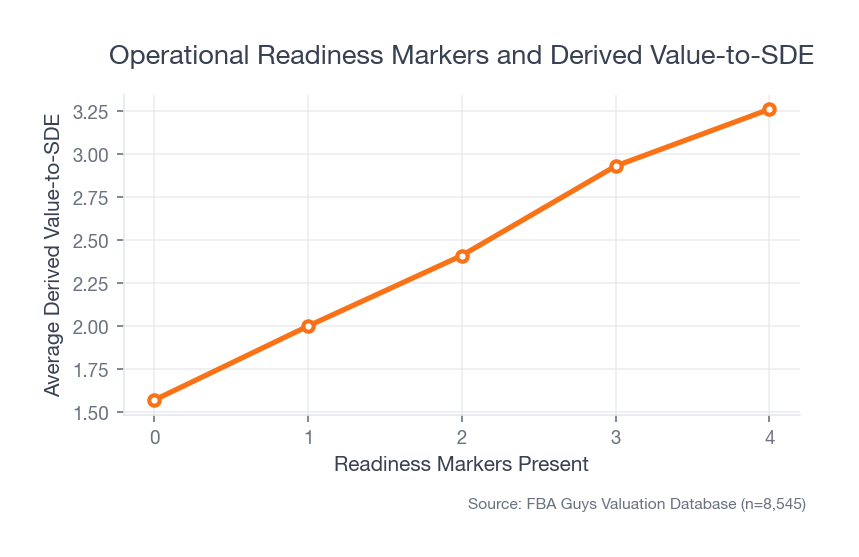
Across 8,548 successful FBA Guys valuations, businesses with no major readiness markers averaged 1.57 derived value-to-SDE. Businesses with three markers averaged 2.93. The four markers we tested were Brand Registry present or claimed, backup vendors, tax returns, and at least some SOP documentation.
Derived value-to-SDE is the calculator valuation divided by derived seller's discretionary earnings. Treat it as a directional valuation proxy, not a closed-deal multiple.
That doesn't prove international expansion creates value. It says something quieter and more useful: businesses that can explain themselves tend to look better in the data.
 Source: FBA Guys Valuation Database (n=8,545)
International expansion is one place where explanation becomes unavoidable.
Start With the Marketplace, Not the Map
The first expansion decision is usually framed as geography. Canada, Mexico, the UK, Germany, Japan, Australia. It feels like choosing a destination.
For an operator, the better first question is narrower: which marketplace gives this specific catalog the cleanest test?
Amazon's Global Selling guidance starts with market selection, account setup, product selection, requirements, listing, fulfillment, and management. That sequence is right. It is just easy to rush through the middle because "we already sell this product in the US" feels like evidence that the product should travel.
Sometimes it can.
Sometimes the product lands in a country where the category is gated, the compliance documents are different, the plug type is wrong, the label needs local language changes, the return economics are worse, and the best comparable ASIN stops being comparable once VAT, duty, freight, and exchange-rate movement walk into the room.
The fact is, marketplace choice should be an evidence question before it becomes an ambition question.
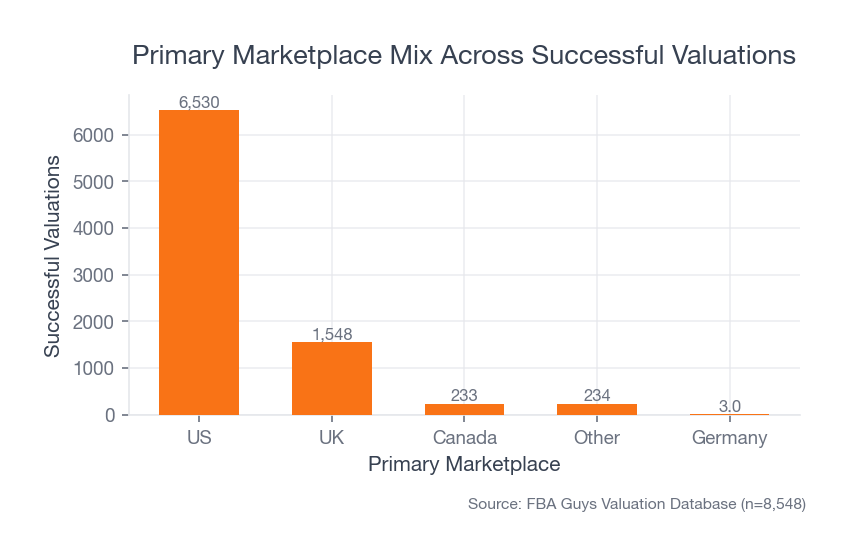
In the FBA Guys database, the US is still the primary marketplace for most businesses we evaluate: 6,530 of 8,548 successful valuation records with marketplace data, or 76.4%. The UK was next at 18.1%. Canada and "other" markets each sat at 2.7%. The concentration itself isn't surprising. Amazon.com is huge, familiar, and often where US-based sellers begin.
 Source: FBA Guys Valuation Database (n=8,548)
The more interesting row came from cross-border sellers. UK-based businesses with the US as their primary marketplace averaged 2.43 derived value-to-SDE across 228 records, compared with 2.04 for UK businesses whose primary marketplace was the UK. That isn't a recommendation for every UK seller to sprint into the US. It is a reminder that cross-border marketplace fit can be real when the business can carry it.
Can your product carry it?
That question is more useful than "Which countries does Amazon make available?"
Check Whether the Product Can Actually Travel
Product eligibility is where an expansion plan starts acting less like a growth plan and more like a compliance file.
Amazon says product categories, taxes, regulations, product compliance, safety rules, and listing requirements vary by country. Some categories require approval, and some can't be sold by third-party sellers. This is the paragraph where the enthusiasm typically gets quieter.
Good.
At this stage, you want five answers before inventory moves: whether the category is open, whether the product requires approval, whether the label and packaging comply locally, whether the ASIN or brand has restrictions in that store, and whether the product claims still make sense in the local language.
That last point saves money. A product can look eligible from a listing screen and still fail later because the paperwork, label, importer setup, or claim language wasn't ready.
This is also where Brand Registry earns its early place in the checklist.
Businesses in our database with Brand Registry present or claimed averaged 2.59 derived value-to-SDE across 6,490 records. Businesses with no Brand Registry averaged 1.81 across 2,046 records. That gap isn't an international-expansion claim. It is a defensibility signal, and defensibility gets more important when the listing spreads across more stores, more languages, and more catalog surfaces.
Amazon currently says Brand Registry requires a brand name and logo permanently affixed to products or packaging, plus a pending or registered trademark from a government trademark office in a country with a corresponding Amazon store. Once enrolled, Brand Registry opens tools for content, analytics, experiments, and brand protection.
Protect the brand before multiplying the places where the brand can get messy.
Choose the Fulfillment Model Before You Copy the Listing
The first outline for this article had seven country-selection steps before fulfillment showed up. It was the wrong article.
Fulfillment changes everything downstream: price, duty, tax, delivery promise, return handling, inventory allocation, customer support, and cash timing. If you choose fulfillment late, you are really choosing to redo the math late.
Amazon gives US sellers several broad international fulfillment paths. FBA Export can let international customers buy export-eligible products stored in US fulfillment centers from Amazon.com. Remote Fulfillment with FBA can use US FBA inventory to reach customers in Canada, Mexico, and Brazil. FBA worldwide means sending inventory into fulfillment centers in the destination country. Fulfilled by Merchant puts more of the shipping and customer-experience burden back on you or your logistics provider.
Each path answers a different operating question.
FBA Export is the lightest test. You may reach some international customers without building a full local-market operation. Remote Fulfillment is a broader North America and Brazil test using US FBA inventory. FBA worldwide is more committed because inventory crosses into that country's fulfillment network. FBM can work, but now international shipping times, duties, customer expectations, and returns live closer to your desk.
Those options sound clean when listed in a row. In the business, they pull on the same inventory pool, cash plan, and service promise. If US demand spikes, do you reserve inventory for the primary market or let Canada keep selling? If Mexico has a better conversion rate but a worse return path, which country gets the next purchase order? If the UK launch works, do you air freight the second batch and watch margin get thinner, or wait for ocean freight and lose the early signal?
Nobody wants the expansion plan to become a weekly inventory argument, but that is often where the real plan lives.
Our supplier-region cross-tabs were more interesting than expected. US-primary businesses sourcing from China averaged 2.67 derived value-to-SDE across 2,905 records. US-primary businesses sourcing from the USA averaged 2.39 across 3,046. UK-primary businesses sourcing from China averaged 2.18 across 673 records, compared with 1.93 for Europe-sourced suppliers across 689 records.
That doesn't make China "better." It makes the lazy nearshoring story too thin. The useful question is whether the supply chain can support the target marketplace at the landed cost, lead time, and reliability the SKU needs.
For international expansion, fulfillment isn't a backend choice. It is the shape of the test.
Rebuild the Unit Economics by Country
Do the math again.
Not a copy of the US math with a currency conversion column at the end. A real country-level model.
At minimum, each target marketplace needs its own view of local selling price, referral fee, fulfillment cost, inbound freight, duty, VAT or GST exposure, currency conversion cost, return cost, language-support cost, advertising cost, inventory carrying cost, and contribution margin by unit.
This looks excessive until the first country-level P&L is wrong.
A product can be a good SKU in the US and a mediocre SKU somewhere else. The price may be lower, the category fee different, the shipping path longer, the returns more expensive, the ad auction thinner, or the packaging requirement more annoying than expected. One extra insert card in the right language is trivial. One wrong compliance label on a full production run isn't.
To illustrate: a product selling for $39.99 in the US might need to sell for the local equivalent of $46 after duty, VAT handling, currency cost, and local FBA fees. The market may accept that. It may also sit on the page looking a little too proud of itself.
This is where landed-cost work earns its keep. If the business already struggles to keep landed cost current in one country, a second country makes the stale assumptions travel faster.
The readiness data gave us the same nudge from a different angle. Businesses with tax returns averaged 2.68 derived value-to-SDE across 4,743 records. Businesses without tax returns averaged 2.10 across 944. Tax returns don't cause international expansion to work. They do signal that the business can document what happened after the money moved.
International selling creates more money movement.
The model has to show it.
Protect the Brand Before the Listing Spreads
Brand protection gets treated like a legal checkbox until the catalog starts multiplying.
Then it becomes operational.
A listing in another country may need translated copy, converted units, localized claims, new imagery, different compliance language, and a price rule that doesn't quietly train customers to buy in the wrong place. Build International Listings can cross-list products, synchronize prices, adjust for currency conversion, and in many cases translate listings into the local language.
Useful. Still worth checking by hand.
Machine-translated bullets can be technically correct and commercially strange. Size charts can be converted and still confuse customers. Images can comply and still feel imported in the worst sense of the word. A product that sells through trust in one country may need different trust signals in another.
(This is the part of international expansion where a spreadsheet person and a product-page person need to sit in the same room. Briefly. No one has to enjoy it.)
Your brand checklist should cover Brand Registry status, trademark coverage, catalog-page control, translated copy, A+ Content, sizing, measurements, claims, pricing rules, duplicate listings, unauthorized sellers, and content drift after launch.
One marketplace teaches you how organized the catalog is. A second marketplace grades the answer.
Make Compliance, Tax, and Support Somebody's Job
International expansion fails quietly when no one owns the boring parts.
That is a workload design problem.
Someone has to own tax research, compliance documents, product-safety files, country-specific listing checks, marketplace messages, returns, warranty expectations, inventory routing, pricing rules, ad spend, and the first-month post-launch report. If everyone assumes Amazon's tool handled it, the first real exception becomes a scavenger hunt.
Our backup-vendor data is a useful proxy for this kind of discipline. Businesses with backup vendors averaged 2.50 derived value-to-SDE across 4,967 records. Businesses without backup vendors averaged 2.28 across 3,581. The backup-vendor group also carried higher average inventory, which makes sense. Redundancy usually costs money before it creates comfort.
International expansion has the same tradeoff.
You may need a customs broker, VAT advisor, translation resource, local compliance support, customer-service coverage, or a 3PL. Some of those people only matter if the market works. Some matter before the first shipment leaves.
How do you know which is which?
Write down the first 30 days after launch as a process, not a hope. Who checks listing health? Who reviews stranded inventory? Who watches exchange-rate movement? Who answers the first customer message in another language? Who decides whether a return goes back to Amazon, a local address, disposal, or some expense category called "International Misc" three months later?
The messy detail matters because that is where the cost hides.
SOPs are a small sample in our structured data, but the pattern fits the Playbook and common sense. Comprehensive SOP documentation averaged 3.00 derived value-to-SDE across 130 records. Some SOP documentation averaged 2.69. Minimal and none sat around 2.51 and 2.49.
That isn't enough to build a whole article around. It is enough to say the work should be written down before the business adds a country.
The Amazon International Expansion Checklist
Use this as a working checklist before you launch a new Amazon marketplace.
- Marketplace fit: Identify the target marketplace, check local demand, review competitors, compare price bands and review depth, and decide what success should look like in the first 30, 60, and 90 days.
- Product eligibility and compliance: Confirm the category is open, check approval requirements, review safety and labeling rules, collect documents before inventory moves, and verify any ASIN, brand, or product-type restrictions.
- Brand and listing control: Confirm Brand Registry status, review trademark coverage, choose Build International Listings or country-specific listings, check translated copy manually, and monitor duplicate listings or content drift.
- Fulfillment model: Choose FBA Export, Remote Fulfillment with FBA, FBA worldwide, FBM, or a staged combination. Confirm eligibility, delivery promises, returns, and inventory allocation before launch.
- Country-level unit economics: Rebuild the P&L by country. Include local fees, fulfillment, freight, duties, taxes, currency conversion, returns, customer support, advertising, and carrying cost.
- Tax, customs, and payment setup: Review tax and regulatory obligations, decide whether you need a tax advisor or customs broker, confirm importer/exporter responsibilities, and document payment conversion.
- Customer support and operations: Assign customer messages, local-language templates, returns, warranty expectations, listing health, stranded inventory, alerts, and launch reporting.
- Reporting and stop-loss rules: Track sales, contribution margin, returns, ad cost, inventory movement, and support issues by country. Decide before launch when to reorder, pause, reprice, lower ad spend, or exit.
The stop-loss rule is worth writing while everyone is still optimistic.
Expansion plans are good at recording upside. They are less enthusiastic about defining the moment when a test has become expensive clutter. If the marketplace can't hit the minimum contribution margin by the review date, or if support and compliance work are pulling attention from the primary business, pause before ordering more inventory.
When Expansion Is Worth It
International expansion is worth testing when the product has demand, the unit economics survive country-level math, the brand is protected, fulfillment is clear, compliance is assigned, and the business can track the new marketplace without blurring the old one.
That is a longer sentence than "sell globally."
It is also closer to the work.
The data doesn't ask you to avoid international growth. Growth paths matter. Buyers like businesses with credible upside, and geographic expansion can be real diversification even when it stays inside Amazon.
The data just keeps asking for the same grown-up inputs before the exciting part begins: clean records, brand control, supplier redundancy, tax documentation, and process discipline.
Another country can be a terrific growth channel.
It can also be a second set of problems wearing a flag.
The difference usually shows up before launch, in the checklist nobody wanted to finish.
Curious what your business is worth?
Get a free, instant valuation and see how your Amazon business stacks up.
Get Your Free Valuation