Amazon Valid Tracking Rate Requirements: The Scan Is the Proof
The FBA Guys
July 23, 2026

A valid tracking problem usually starts after the seller has already done something that looks correct.
The label was bought. The tracking number was entered. The package left the warehouse. The customer can see a string of numbers in the order record.
Then Seller Central says the package didn't count.
Amazon valid tracking rate requirements are stricter than "add a tracking number." Amazon's current public guidance requires sellers shipping seller-fulfilled packages to maintain a Valid Tracking Rate of 95% or higher at the product-category level. Valid tracking means Amazon can verify the tracking information through the carrier and service record, including carrier scans where Amazon requires them.
That distinction matters. VTR measures whether the carrier evidence reached Amazon in a form Amazon accepts.
What Amazon Valid Tracking Rate Measures
Valid Tracking Rate applies to seller-fulfilled packages. Normal FBA fulfillment isn't the lane this metric is measuring, because Amazon handles the fulfillment and tracking record for those orders.
The difficult cases usually sit inside mixed accounts. A seller can be 90% FBA and still have VTR exposure from a few seller-fulfilled offers: oversized SKUs, seasonal inventory, warehouse-held units, backup FBM offers, replacement parts, or a temporary workaround while FBA inventory is unavailable.
Amazon's current Valid Tracking Rate help page describes the requirement at the product-category level. That category-level denominator is where the math gets sharp.
If one category has 20 seller-fulfilled packages in the measurement window and one is invalid, the category is at 95%. If two are invalid, it is at 90%. The rest of the account can have hundreds of FBA orders, but those orders don't dilute the seller-fulfilled category being measured.
That is why a small side process can create a loud account-health problem.
The current public threshold is 95% or higher. Sellers should still check the live Seller Central page before changing a process, because Amazon policy language, carrier lists, exemptions, and program-specific requirements can change.
What Counts as Valid Tracking
The short answer is that Amazon needs a tracking record it can validate.
That usually means four things have to line up:
- The tracking ID is present.
- The carrier name is entered correctly.
- The shipping service is one Amazon can recognize for that shipment.
- The carrier provides the required scan events.
The scan requirement is where many VTR problems stop being clerical.
Amazon's VTR FAQ and official update language refer to carrier scans. A carrier scan is an event the carrier records as the package moves through its network. In plain operating terms, the package has to become visible in the carrier system, not only in your label software.
Amazon's official update to Valid Tracking Rate guidelines said that starting January 15, 2025, it revised VTR and updated exemptions for new shipping regions and package values. For shipments to the US from China, Canada, American Samoa, or the US Minor Outlying Islands, Amazon described one valid carrier scan for packages valued under $5 and two scans for packages at or above $5. For shipments to the US from India or the UK, Amazon described one scan below $15 and two scans at or above $15.
The values in that update exclude taxes and include shipping charges.
The same update also listed exemptions, including digital products, certain domestic low-value USPS envelope shipments, domestic packages shipped by listed freight carriers, some UK or India to US low-value shipments using Amazon-integrated untracked services, and packages shipped to the US from places outside the named origin list.
This is why a single VTR rule of thumb can get sellers into trouble. Package value, origin country, carrier, service, and category can change what Amazon expects.
Build the Carrier Matrix Before the Metric Falls
The easiest VTR control is a carrier matrix.
This doesn't have to be complicated. It has to answer the questions that create invalid packages before the shipping team is under pressure.
Start with product category and marketplace. Then list each approved carrier and service for that category. Add the package types that service can handle, the package-value range, the origin country if international shipping is involved, and whether the service normally produces one scan, two scans, delivery confirmation, or only a basic movement record.
The carrier matrix should also say which services are banned.
That sounds heavy until one order goes out through a local courier, a hand-delivery option, a cheap envelope service, or a 3PL default method that Amazon can't validate. The carrier may be real. The package may arrive. The customer may be happy. The VTR record can still fail if Amazon can't read the tracking path.
For a low-volume category, one failure can matter. If the category has 12 seller-fulfilled packages in the window, 11 valid packages and one invalid package equals 91.7%. The category can be below the threshold even though the shipping team missed only one package.
A carrier matrix also keeps exceptions from becoming folklore. If a domestic low-value USPS envelope shipment appears exempt under Amazon's current rule, write down the rule, service, package value, and order examples. If a UK or India to US low-value service appears exempt, write down how the service appears in the carrier and shipping-service dropdown when shipment is confirmed.
That file gives the operator a way to act before a dashboard warning appears.
Why the Carrier Handoff Matters
The most useful place to look is the handoff between shipment confirmation and the first carrier scan.
That is the moment where the package leaves your process and enters a system Amazon can read. If the label is printed but the carrier never scans the package, the tracking record can look complete internally and still fail the metric. If a 3PL confirms shipment but uploads the tracking ID late, the package may move before Seller Central has the record. If a local carrier is real but not integrated, the customer may receive the order while Amazon still treats the tracking as invalid.
Amazon's Buy Shipping reduces part of this risk because it automates shipment confirmation and valid tracking. It doesn't remove the need for a real carrier handoff. The package still needs to move through the carrier process in a way Amazon can validate.
There is a related timing issue. Amazon's pre-confirm ship abuse guidance warns about seller-fulfilled orders that are ship-confirmed well before the package is handed to the carrier. The current help page tells sellers to make sure carriers pick up and scan the package promptly after label purchase.
That guidance is aimed at a specific abuse pattern, but the operating lesson is broader: don't let shipment confirmation get too far ahead of physical carrier evidence.
Valid Tracking Rate also sits near late shipment rate, but the two metrics answer different questions. Late shipment rate looks at whether shipment confirmation happened on time. VTR looks at whether the tracking record was valid. A package can be confirmed on time and still fail VTR if Amazon can't validate the carrier record.
Pull the VTR Report Before You Guess
The dashboard percentage tells you there is a problem. The report tells you what kind of problem it is.
Pull the VTR report for the affected category and build a working table. For each invalid package, capture:
- Order ID.
- SKU and ASIN.
- Product category.
- Ship-confirm date and time.
- Promised ship date.
- Carrier selected in Seller Central.
- Shipping service selected in Seller Central.
- Tracking ID.
- First carrier scan timestamp.
- Delivery or attempted-delivery scan, if required.
- Package value, excluding taxes and including shipping where relevant.
- Origin country where relevant.
- Whether the label came from Buy Shipping, a 3PL, or another tool.
- Whether the shipment appears exempt under the current Amazon rule.
Then add a cause column.
Most invalid packages fall into a small set of causes:
- Missing tracking ID.
- Wrong carrier name.
- Wrong shipping service.
- Non-integrated carrier.
- No first carrier scan.
- Missing delivery or attempted-delivery scan where required.
- Tracking ID uploaded late.
- Shipment confirmed before carrier handoff.
- Self-delivery or local delivery entered in a way Amazon didn't validate.
- 3PL or software integration sent stale data.
- Package-value or origin-country threshold misunderstood.
- Legitimate exemption not reflected cleanly in the report.
Those are different problems.
A wrong carrier name needs a data-entry or integration fix. A missing first scan needs a handoff fix. A non-integrated carrier needs a carrier-selection fix. A 3PL upload delay needs an SLA and timing fix. An exemption dispute needs the exact Amazon rule, the order record, and proof that the shipment fits the exemption.
The report should keep those separate.
Where Low-Value and Local-Delivery Shipments Get Messy
Low-value packages are where VTR becomes an economic decision.
A tracked service can cost more than the margin on a sticker, replacement part, sample, book, or envelope-sized accessory. Amazon's exemption language exists because not every shipment behaves like a standard parcel. The trap is assuming a shipment is exempt because it feels too small to track.
Work from the current rule, not from habit.
If the package is a domestic low-value USPS envelope, verify the exact service Amazon lists. If the package ships to the US from one of the named origin countries in the 2025 update, verify the package-value threshold and scan count. If the package ships through a freight carrier, verify that the carrier is in Amazon's listed group for the exemption. If the package uses an untracked integrated service, save the Seller Central evidence showing that service was available for that order type.
Self-delivery deserves special caution. The buyer can receive the package perfectly and the VTR record can still be weak. If Amazon can't validate the delivery path, the order may not help the metric. For bulky local items, furniture, event inventory, or a one-off customer accommodation, check the current delivery-option guidance before using a generic carrier entry.
The business choice may be uncomfortable. If the economics only work with an untracked method Amazon won't validate, the Amazon seller-fulfilled offer may not belong live in that category. FBA, a tracked service, a different bundle size, a higher minimum price, or an off-Amazon channel may be the cleaner operating answer.
That is a margin decision, not just a compliance decision.
Hybrid FBA and FBM Accounts Need a Separate Control
The FBA Guys valuation database doesn't store exact VTR. It stores fulfillment method, and that is useful context for this topic.
Among 8,579 successful valuations with usable calculated SDE and derived value-to-SDE ratios between 0.5 and 10, FBA records had a 2.68 median derived value-to-SDE across 6,209 records. Hybrid FBA/FBM records had a 2.21 median across 1,990 records. FBM records had a 1.64 median across 380 records.
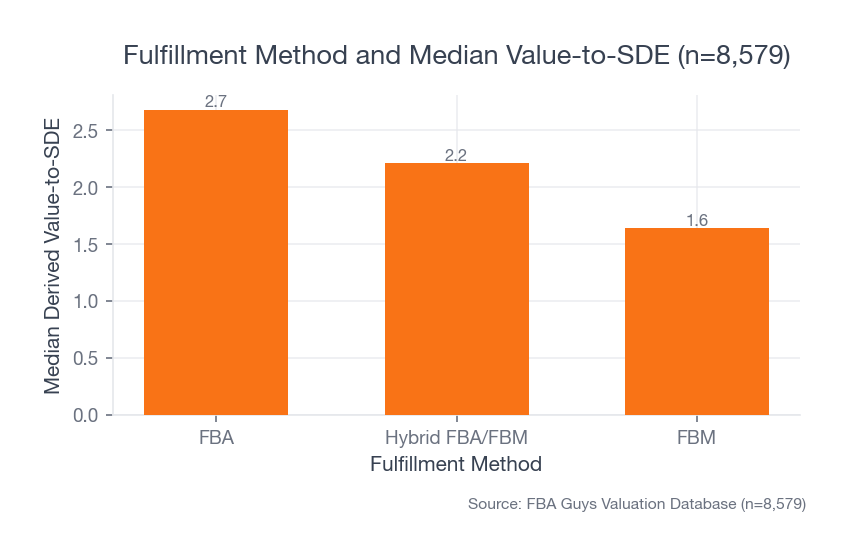 Source: FBA Guys Valuation Database (n=8,579 successful valuations with usable calculated SDE)
That doesn't prove fulfillment method caused the valuation gap, and it certainly doesn't prove VTR caused it. The database can't see exact VTR.
The more careful reading is that merchant-fulfilled exposure travels with a different operating burden. That burden can be worth carrying, especially when FBM protects sales during FBA stockouts or makes oversized SKUs workable. It just needs its own control file.
The hybrid count is the more interesting part. Hybrid records outnumbered pure FBM records 1,990 to 380 in the filtered sample. VTR exposure also lives inside businesses that mostly run through FBA.
For a hybrid account, list the seller-fulfilled lane explicitly:
- Which SKUs are allowed to be seller-fulfilled?
- Why are they seller-fulfilled?
- Which carriers and services are approved?
- Which categories have low seller-fulfilled volume?
- Which shipments require one scan?
- Which shipments require two scans?
- Which shipments may be exempt?
- Who checks the first scan?
- Who checks the VTR report?
- Who can turn FBM offers on or off?
If that list lives only in someone's memory, the category can fall below 95% before the broader account looks unhealthy.
What to Do If Valid Tracking Rate Is Already Below 95%
The first job is to stop new invalid packages from entering the window.
Start with the affected category. Pause seller-fulfilled SKUs where the carrier, service, scan, or exemption status is uncertain. Move current shipments to an Amazon-integrated carrier and service where the economics still work. If the SKU can move back to FBA, check the operational cost before leaving the FBM offer active.
Then review open seller-fulfilled orders due today and tomorrow. Confirm that every package has the correct carrier, correct service, correct tracking ID, and a handoff process that will produce the required scan.
Only then write the appeal or response.
If seller-fulfilled listings are deactivated, the Account Health response should explain the actual cause. A useful response names the affected orders, what made the tracking invalid, what changed, who owns the new check, and how the seller will monitor the category until the metric recovers.
The related seller performance notification process is about the record as much as the wording. If the issue reaches appeal territory, the seller account suspension appeal file should include the order-level proof, not only a policy promise.
The database gives one useful account-health boundary here. In 472 records with populated suspension history and usable derived value-to-SDE, never-suspended records had a 3.10 median. Warnings-only records had a 3.07 median. Resolved suspensions had a 2.38 median. Active-issue records had only six entries, too few for a clean read.
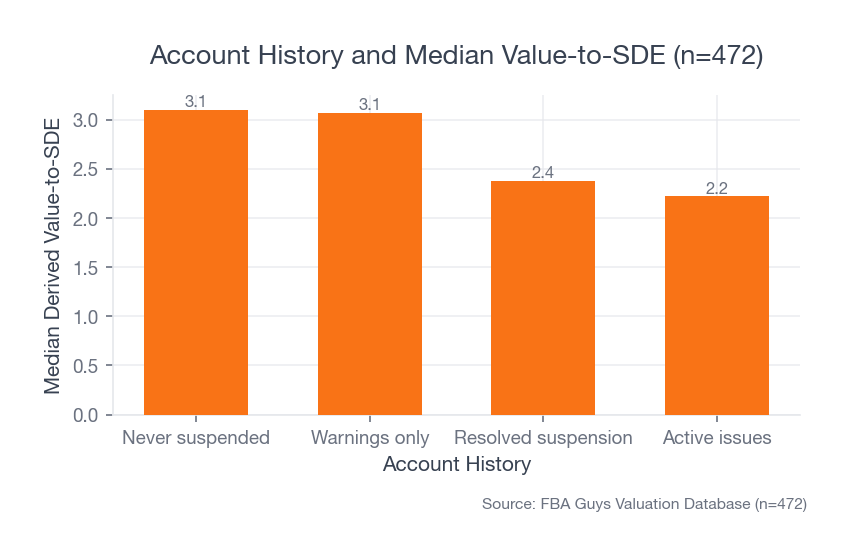 Source: FBA Guys Valuation Database (n=472 successful valuations with populated account-history data and usable calculated SDE)
That doesn't mean warnings are harmless. It suggests a warning handled early and documented cleanly is a different future fact from a suspension history that has to be explained later.
Build a Weekly VTR Control File
The recurring control can be simple.
One tab tracks the category-level metric:
- Product category.
- Seller-fulfilled package count.
- Valid package count.
- Invalid package count.
- VTR percentage.
- Current 95% buffer.
- Active seller-fulfilled SKUs in the category.
- Owner.
- Follow-up date.
The second tab tracks invalid or risky packages:
- Order ID.
- SKU and ASIN.
- Carrier.
- Service.
- Tracking ID.
- First scan status.
- Delivery or attempted-delivery scan status where required.
- Origin and package value where relevant.
- Exemption status.
- Root cause.
- Corrective action.
- Preventive action.
The third tab is the carrier matrix. It should show which carriers and services are approved by category, marketplace, package type, package value, and origin country. If a 3PL ships orders, include the 3PL's upload timing and the person responsible for checking scan visibility.
This is where VTR connects to business transferability.
In the same account-health response set, comprehensive SOP records had a 3.53 median derived value-to-SDE across 155 records. Records with no SOP documentation had a 2.45 median across 123.
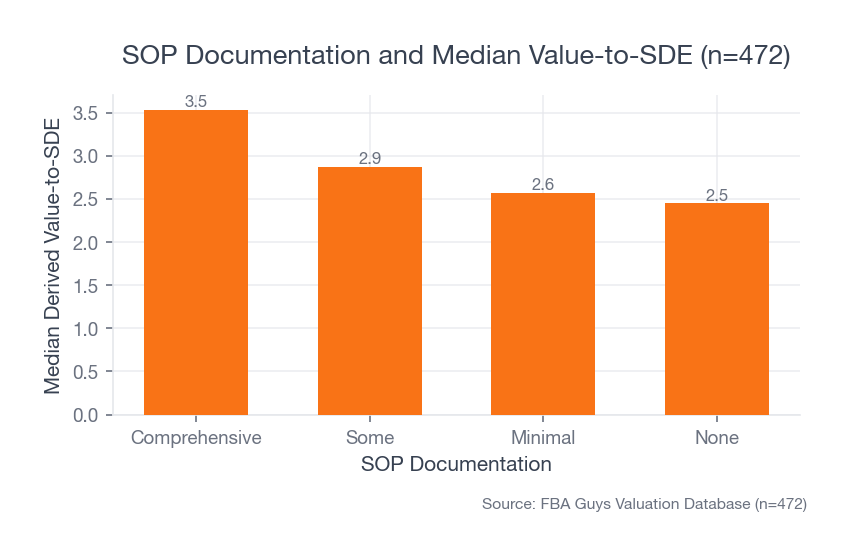 Source: FBA Guys Valuation Database (n=472 successful valuations with populated SOP-documentation data and usable calculated SDE)
Again, the data doesn't prove that a VTR spreadsheet creates a higher valuation. Our read is narrower: businesses that can document their operating controls tend to show up differently from businesses where every account-health issue has to be reconstructed from memory.
The weekly file also helps with the Amazon suspension prevention checklist. The point is to catch the weak process while it is still a report line, not after the category has already been restricted.
FAQ
Does Valid Tracking Rate apply to FBA orders?
Valid Tracking Rate applies to seller-fulfilled packages. Normal FBA orders aren't the lane this metric is measuring. Mixed accounts still need a VTR control because a small seller-fulfilled category can create exposure inside an otherwise FBA-first business.
Is Amazon's VTR requirement 95%?
Amazon's current public guidance requires 95% or higher VTR at the product-category level for seller-fulfilled packages. Check the live Seller Central VTR help page before acting, because marketplaces, categories, carrier rules, exemptions, and program requirements can change.
Does Buy Shipping guarantee valid tracking?
Buy Shipping reduces tracking-entry risk because it automates shipment confirmation and tracking information. It is still worth checking that the carrier scans the package and that the service fits the shipment. A label record is strongest when it is paired with carrier evidence.
What if the carrier missed the scan?
Save the carrier tracking page, label record, shipment confirmation, pickup record, and any 3PL timestamps. Then decide whether the carrier or handoff process should stay approved. If one carrier repeatedly fails to produce scans Amazon can read, the issue is no longer a one-off exception.
Does Valid Tracking Rate affect the value of my Amazon business?
The valuation database can't prove a direct VTR-to-valuation relationship because it doesn't store VTR. It shows adjacent patterns around fulfillment method, account-history status, Account Health Rating, and SOP documentation. Treat VTR as part of the account-health and transferability file, not as a standalone valuation formula.
The Practical Takeaway
Valid Tracking Rate is a shipping evidence system.
For each seller-fulfilled category, the work is concrete: use a carrier and service Amazon can validate, confirm shipment close to the actual handoff, make sure the carrier scan happens, save the exceptions, and review the report before one bad category becomes an Account Health event.
The scan is the proof. Build the process around that.
Curious what your business is worth?
Get a free, instant valuation and see how your Amazon business stacks up.
Get Your Free Valuation