Amazon FBA Customs Clearance Process: The Entry Record Is Part of the Cost
The FBA Guys
June 16, 2026

One customs entry can outlive the shipment.
The inventory arrives, Amazon receives it, and the SKU starts selling. Six months later, the same shipment is back in front of you because the gross margin moved, the duty line changed, a buyer asked for import records, or a new operator needs to understand why landed cost was different on the last reorder.
For the amazon fba customs clearance process, the practical answer is this: your shipment needs the right importer of record, product classification, shipment documents, customs filing, duty payment, release, and delivery path before Amazon can receive the inventory cleanly. The better business answer is that customs clearance creates the record behind landed cost, inventory timing, and importer liability.
FBA stands for Fulfillment by Amazon. Amazon can store, pick, pack, and ship your inventory after it enters the fulfillment network. It doesn't make the import responsibility disappear before the inventory gets there.
The Amazon FBA Customs Clearance Process, Step by Step
The exact process depends on country of origin, freight mode, product type, broker, port, and whether another agency needs to review the product. A basic US-bound FBA import usually follows this path:
- Confirm the importer of record and tax or importer number.
- Classify the product with the correct HTS code.
- Build the commercial invoice, packing list, purchase order, and product compliance file.
- Book freight through Amazon Global Logistics, a third-party forwarder, a broker-connected route, or supplier-arranged shipping.
- File Importer Security Filing, or ISF, if the cargo is arriving by ocean vessel.
- Submit customs entry data through the broker or qualified filer.
- Deposit estimated duties, taxes, and fees where required.
- Receive CBP release.
- Move the inventory to Amazon, AWD, a 3PL, or another receiving point.
- Reconcile the final customs and freight records into landed cost.
That last step is easy to skip because the shipment feels finished once Amazon starts receiving units. It is also where the process becomes useful later.
Customs clearance isn't only about getting boxes through a port. It is the point where product description, country of origin, customs value, HTS classification, duty, and admissibility all get turned into a record.
CBP describes entry summary as the documentation used to assess duties, collect statistics, and determine whether legal requirements have been met. CBP also says Form 7501 is used for information such as appraisement, classification, and origin.
Those aren't just government words. They are the same facts that explain why a unit cost changed.
Who Is the Importer of Record for FBA Inventory?
For a normal FBA import, you should assume Amazon isn't your importer of record.
Importer of record means the party responsible for the import entry, duty payment, and customs compliance record for the shipment.
Amazon's global-selling guidance says that when sending inventory to Amazon fulfillment centers in other countries, you or your provider must act as exporter of record and importer of record, comply with the applicable laws, and handle duties, import taxes, and fees. Amazon also says it isn't responsible for customs duties and taxes associated with FBA inventory, and shipments arriving at an Amazon fulfillment center with customs duty charges due can be returned to the sender.
That is the responsibility layer many sellers blur when a supplier says, "We can ship directly to Amazon."
The supplier may be able to arrange freight. The forwarder may be able to book the route. The customs broker may be able to file the entry. A customs broker is a CBP-licensed professional who can conduct customs business on behalf of an importer. CBP's new importer guidance still says that even when a customs broker is used, the importer of record is ultimately responsible for the correctness of the entry documentation and applicable duties, taxes, and fees.
So the first question is simple: who appears as importer of record?
The second question is better: can you prove what was filed?
If the answer is sitting inside a supplier's WeChat thread, the process may work for a small shipment. It becomes weaker as the SKU gets more valuable, the reorder cycle gets more repeatable, or the business needs cleaner records.
The Document Packet You Want Before the Shipment Leaves
The customs file starts before pickup.
At minimum, you want:
- Commercial invoice.
- Packing list.
- Purchase order or supplier invoice.
- Product description detailed enough for classification.
- Country of origin.
- Manufacturer or shipper details.
- Carton count, carton dimensions, and carton weights.
- HTS classification support.
- Product compliance documents where applicable.
- Amazon shipment IDs, carton labels, and destination instructions.
The commercial invoice and packing list need to agree with the physical shipment. The product description should be specific enough that a broker or import specialist can understand the product without guessing. "Kitchen accessory" is usually a weaker description than the actual material, function, and intended use.
This is where the file often starts to fray. The supplier thinks in production terms. The forwarder thinks in transport terms. The broker thinks in entry terms. Amazon thinks in carton labels, shipment IDs, and receiving requirements.
The seller is the one who needs the whole file to tell one story.
Ocean Freight Has an Earlier Customs Deadline
If your FBA inventory is arriving by ocean vessel, ISF matters.
Importer Security Filing, often called ISF or 10+2, applies to cargo arriving in the United States by vessel. CBP guidance says the filing requires certain advance cargo information before vessel cargo can be imported, and failure to comply can lead to penalties, increased inspections, and delay.
The operating problem is timing. ISF needs data before the container is close to arriving. If the supplier hasn't provided a complete manufacturer, shipper, buyer, consignee, country-of-origin, or product file, the customs delay begins before the ship is anywhere near the destination port.
Air freight has its own filing and clearance path, but the ocean ISF deadline is a good reminder of the larger habit: customs clearance starts before the shipment moves.
If your team treats clearance as something the broker handles after arrival, the process is already late.
HTS Codes, Duties, Tariffs, and Landed Cost
The HTS code is the classification that helps determine the duty treatment for the product. The USITC Harmonized Tariff Schedule is the official tariff schedule source for the United States.
The HTS code isn't the only input. Customs value, country of origin, product composition, intended use, tariff actions, and product-specific requirements can all change the final treatment. Some products also involve agencies beyond CBP.
This is why a customs broker can be useful. It is also why you want the classification reasoning in the file, not only the final code.
For FBA sellers, the customs number becomes useful when it enters landed cost. Landed cost is the total cost to get sellable inventory ready for sale or fulfillment. It typically includes product cost, freight, insurance, duties, tariffs, customs broker fees, destination charges, prep, labels, pallets, Amazon inbound costs where applicable, and units lost or rejected along the way.
If duties are buried in a supplier quote, the unit economics may look stable until something changes. If duties are separated and tied to the product, route, and HTS support, you can see whether margin moved because of factory cost, freight, tariff treatment, Amazon fees, or receiving loss.
Our Amazon FBA duty and tariff calculator is built around that same idea. The rate matters, but the business needs a repeatable cost build-up.
There is also a small-parcel caveat. As of the writing of this article, CBP's e-commerce FAQ says duty-free de minimis treatment has been suspended for low-value shipments from all countries. If your import routine still assumes the old under-$800 treatment, confirm the current rules with CBP guidance and your broker before building that assumption into pricing.
Why Clearance Problems Become Inventory Problems
The FBA Guys database doesn't store customs clearance events directly. We can't see ISF filings, broker names, HTS disputes, customs exams, duty payments, port delays, or Amazon receiving delays.
What we can see is the operating context around imports.
Among 8,581 successful valuation records, 3,825 list China as supplier location. That is 44.6% of the successful records in the database. USA supplier records account for 3,145, Europe for 901, Other for 697, India for 11, and Vietnam for 2.
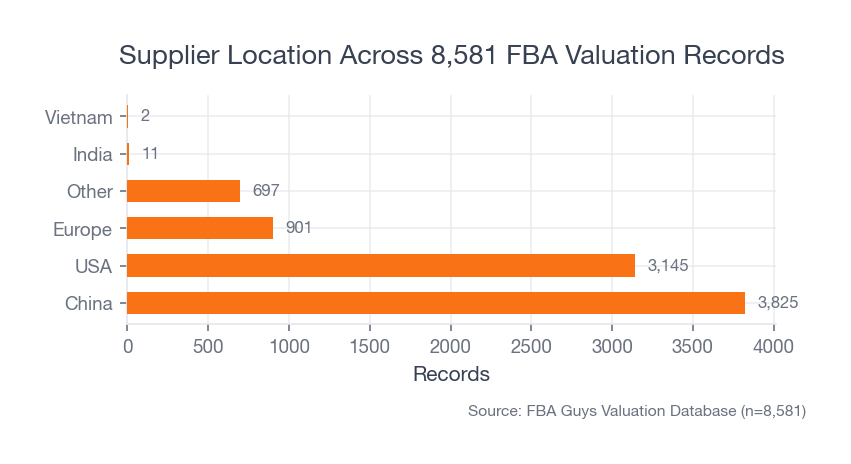 Source: FBA Guys Valuation Database (n=8,581)
That doesn't mean every China-sourced shipment had a customs problem. It means foreign supplier exposure is common enough that import records shouldn't be treated as a side folder.
The inventory timing pattern is more useful. China-sourced records had 24.7% of records in the several_months or year_or_more inventory-turnaround groups, compared with 14.7% for non-China or other supplier records. China-sourced records also averaged inventory equal to 18.0% of annual sales, compared with 16.1% for non-China or other.
The more careful reading is that import cycles tend to sit closer to cash timing. A customs delay can be a paperwork issue for the broker. For the business, it can become a reorder issue, a stockout issue, or a month where the landed-cost file doesn't explain the P&L.
Inventory turnaround shows the same pressure from another angle. Every-few-months records were the largest group in our query, with 4,226 records and 2.51 average derived value-to-estimated-SDE. Several-month records averaged the highest inventory, $205,171, and 2.29 derived value-to-estimated-SDE. Year-or-more records averaged 2.07.
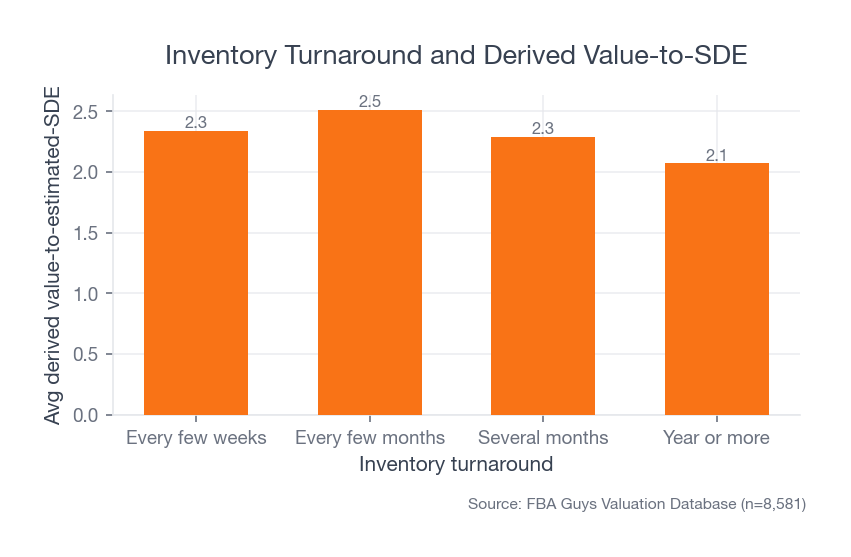 Source: FBA Guys Valuation Database (n=8,581)
SDE means Seller's Discretionary Earnings. It is the profit stream available to one owner-operator after adding back legitimate owner benefits and one-time expenses. In this analysis, derived value-to-estimated-SDE is valuation output divided by estimated SDE from the valuation form fields. It is a proxy, not a closed-sale multiple.
Stockouts give the other side of the same process. Rare-or-never stockout records averaged 2.55 derived value-to-estimated-SDE across 2,832 records. Few-times-per-year records averaged 2.36 across 755 records. Frequent-stockout records averaged 2.06 across 307 records.
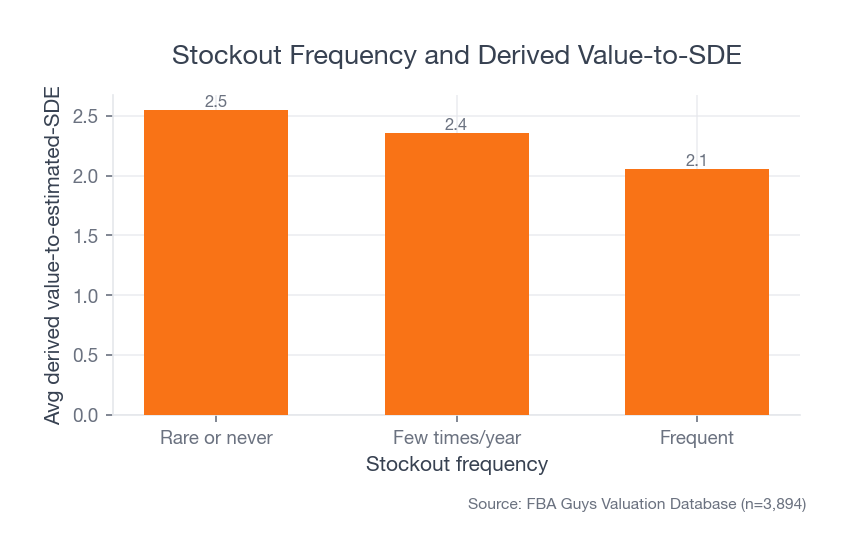 Source: FBA Guys Valuation Database (n=3,894)
Customs clearance doesn't cause those numbers by itself. The database can't support that claim. The useful point is narrower: import delay, inventory timing, and stockout exposure are close enough that customs needs to be part of the reorder system, not only part of freight.
Customs Records Make Backup Vendors Real
A backup supplier is only partly a supplier question.
If the backup vendor can't produce the right documents, ship under a clear Incoterm, support the HTS classification, meet Amazon carton requirements, and give you a landed-cost file you can trust, it isn't a full backup route yet.
The database pattern is worth looking at with that limitation in mind. China-sourced records with backup vendors averaged 2.63 derived value-to-estimated-SDE and 16.8% inventory-to-sales across 2,273 records. China-sourced records without backup vendors averaged 2.40 and 19.8% inventory-to-sales across 1,552 records.
The same direction appeared outside China. Non-China or other supplier records with backup vendors averaged 2.39 derived value-to-estimated-SDE, versus 2.19 without backup vendors.
Correlation only. Stronger businesses may be more likely to have backup vendors, better documentation, cleaner inventory planning, more capital, and better records generally.
Still, the operating lesson is useful. Supplier replaceability becomes more believable when the customs path is known. A buyer, lender, new operator, or future team member can understand a backup vendor more quickly if the route has already been tested and the file shows what happened.
Our Amazon FBA supplier negotiation tactics guide covers supplier terms from the negotiation side. Customs adds a different test: can the supplier support the record that makes those terms usable?
Amazon Global Logistics or a Third-Party Forwarder?
Amazon Global Logistics is worth quoting when your route is eligible. Amazon says AGL can ship ocean or air freight from China directly to the Amazon fulfillment network in several marketplaces, plus ocean freight from Vietnam to the US. Its public program page describes services such as pickup at origin, export declaration, cross-border transportation, destination customs clearance, delivery to FBA or AWD, FCL, LCL, and air freight. It also says onboarding includes importer of record details and required documents.
That can be a good fit when the shipment is headed straight into Amazon's network and you want booking, tracking, customs-clearance support, and delivery closer to Seller Central.
A third-party forwarder may fit better when you need a specific customs broker, a non-Amazon warehouse, special prep, multiple destination paths, an existing 3PL relationship, or a route that Amazon's program doesn't support.
Our Amazon FBA freight forwarding explained guide covers those handoffs in more detail. This customs guide is narrower: it follows the entry record and duty file.
Our read: quote the full route, not only the freight line.
For either option, ask:
- Who is importer of record?
- Who is the customs broker?
- What documents are required before pickup?
- What HTS code and duty assumptions are being used?
- What charges are included through Amazon receiving?
- What charges are estimates?
- What happens if CBP examines the shipment?
- When do you receive the entry summary and duty record?
- How are Amazon shipment IDs, carton labels, and destination changes handled?
The better provider isn't always the one with the cleanest quote. It is the one whose process leaves you with a usable file after the shipment clears.
What to Keep After the Shipment Clears
Keep the customs packet with the landed-cost file.
At minimum, store:
- Purchase order.
- Supplier invoice.
- Commercial invoice.
- Packing list.
- Booking confirmation.
- Bill of lading or air waybill.
- ISF confirmation for ocean freight.
- Entry summary.
- Duty, tax, and fee payment record.
- HTS classification support.
- Broker and forwarder correspondence.
- Product compliance documents.
- Amazon shipment IDs and carton labels.
- Receiving discrepancies.
- Final landed-cost calculation.
The file should answer four questions without another email thread:
- What did we import?
- Why did we classify it that way?
- What did it cost to get sellable units into the receiving path?
- What changed from the previous reorder?
This connects directly to transferability. A future operator doesn't need your memory if the customs path, cost build-up, and exceptions are already visible.
The file also protects your accounting. Freight and duty can distort gross margin when they are miscoded, posted in the wrong month, or separated from the inventory they helped bring in. Our Amazon FBA cash flow management guide covers the cash side of that same inventory problem.
FAQ
Do I need a customs broker for Amazon FBA?
You don't always need one for every shipment type, but many FBA importers use a licensed customs broker because classification, entry filing, duty handling, and CBP communication can get complicated. Even when a broker is used, the importer of record remains responsible for the correctness of entry documentation and applicable duties, taxes, and fees.
Can my supplier ship directly to Amazon FBA?
Sometimes, but direct-to-Amazon shipping should still give you a clear importer of record, document packet, duty treatment, freight scope, Amazon shipment labeling, and final landed-cost record. Supplier-arranged shipping is weaker when the quote hides who filed the entry or how duties were handled.
What is the most important customs document for an Amazon seller?
There isn't only one. The commercial invoice, packing list, HTS support, entry summary, and duty payment record work together. If you had to pick the document that proves what was entered and how CBP assessed the shipment, the entry summary is central.
What happens if customs duties are still due when inventory reaches Amazon?
Amazon's global-selling guidance says Amazon isn't responsible for customs duties and taxes associated with FBA inventory, and shipments arriving at an Amazon fulfillment center with customs duty charges due can be returned to the sender. Keep duties handled before the shipment reaches Amazon's receiving path.
Does customs clearance affect Amazon FBA business value?
The FBA Guys database doesn't measure customs clearance directly, so we can't say customs clearance causes a specific valuation change. It can affect the variables that matter around value: landed cost, inventory timing, stockout risk, supplier replaceability, documentation, and transferability.
Conclusion
The Amazon FBA customs clearance process is easy to treat as a logistics task because the broker, forwarder, supplier, or Amazon Global Logistics workflow may handle much of the movement.
The business still needs the record.
Among 8,581 successful valuations in the FBA Guys database, 44.6% list China as supplier location. China-sourced records showed more slow-turning inventory than non-China or other supplier records, and rare-or-never stockout records averaged higher derived value-to-estimated-SDE than frequent-stockout records.
Those numbers don't tell us which broker to use or which port clears fastest. They tell us why the customs file matters. The shipment may be gone, but the entry record keeps explaining the cost, the route, and the next reorder.
Keep the process boring. Keep the file complete. Keep the landed cost readable.
Curious what your business is worth?
Get a free, instant valuation and see how your Amazon business stacks up.
Get Your Free Valuation