Amazon FBA Fee Increases History Timeline: The Rate Card Is Starting to Behave Like an Operating System
The FBA Guys
May 13, 2026

Every Amazon seller has a private fee timeline in their head.
There was the year fulfillment fees went up. The year storage became the problem. The year inbound placement arrived and everyone suddenly had opinions about split shipments. Then, in April 2026, the fuel and logistics surcharge showed up after the annual 2026 fee update had already promised no new FBA fee types.
The Amazon FBA fee increases history timeline is no longer a simple list of annual rate increases. From 2020 through 2023, the story was mostly higher fulfillment costs, storage adjustments, and surcharges. In 2024, Amazon changed the shape of the fee system by separating inbound and outbound work. In 2025, it paused most US referral and FBA fee increases. In 2026, it raised FBA fees modestly in January, then added a temporary fuel and logistics-related surcharge in April.
That is the part worth watching. The fee table still matters. The behavior it rewards and punishes now matters more.
Amazon FBA fee increases history timeline
Here is the practical timeline for US sellers, using Amazon-owned announcements where available. Current rates still need to be checked against Amazon's active selling fee changes and fee preview tools before a seller changes pricing or replenishment.
| Year | Effective date | Main change | What sellers had to notice |
|---|---|---|---|
| 2020 | February 18, 2020 | Amazon announced just over 3% average FBA fulfillment fee increases, select referral fee reductions, higher standard-size storage for January through September, weight-based removal and disposal fees, and a higher label service fee. | The One-Day Delivery investment started showing up in the rate card. |
| 2021 | June 1, 2021 | Amazon delayed its annual fee adjustment into spring, then announced 2-3% average fulfillment fee increases, changes to return processing fees, FBA Liquidations, and higher removal/disposal and manual processing fees. | The pandemic pause ended, but the adjustment was still framed as modest. |
| 2022 | January 18, 2022 | Amazon adjusted FBA fulfillment fees to offset higher permanent operating costs after COVID, labor, and supply-chain pressure. | "Temporary" cost pressure started becoming permanent rate structure. |
| 2022 | April 28, 2022 | Amazon added a 5% fuel and inflation surcharge to FBA fulfillment fees. | Surcharges became part of the seller vocabulary again. Lovely. |
| 2022 | October 15, 2022 to January 14, 2023 | Amazon introduced a holiday peak fulfillment fee for core FBA, apparel, and dangerous goods. | Seasonality moved into fulfillment cost planning. |
| 2023 | January 17, 2023 | Amazon increased FBA outbound fee rates by $0.22 on average and removed the separate fuel and inflation surcharge by folding cost pressure into standard rates. | The surcharge went away as a line item. The cost did not vanish. |
| 2023 | April 1 and April 15, 2023 | Amazon introduced a storage utilization surcharge and expanded aged inventory surcharges, including inventory stored 180-270 days for many categories. | Inventory quality became more expensive to fake. |
| 2024 | January 15, 2024 | Amazon reduced referral fees for apparel products under $20. | Not every fee change was an increase, but category economics got more specific. |
| 2024 | March 1, 2024 | Amazon introduced the inbound placement service fee for standard and Large Bulky products. | Inbound strategy became a unit economics decision. |
| 2024 | April 1, 2024 | Amazon introduced the low-inventory-level fee and reduced non-peak monthly storage fees for standard-size products. | Too little inventory and too much inventory could both become expensive. Nice little box. |
| 2024 | April 15, 2024 | Amazon lowered some outbound FBA fulfillment fee rates at the same time inbound placement fees started being charged. | Sellers had to model the whole flow, not one fee line. |
| 2024 | June 1, 2024 | Amazon expanded the returns processing fee to high-return-rate products in categories beyond apparel and shoes. | Returns became another ASIN-level economics test. |
| 2025 | January 15, 2025 | Amazon said US referral and FBA fee types and rates would not broadly increase, with no new fee types and selected decreases or benefits. | After the 2024 rebuild, Amazon gave sellers a quieter year. |
| 2026 | January 15, 2026 | Amazon announced average FBA fee increases of $0.08 per unit, less than 0.5% of an average item's selling price, with no new FBA fee types in the annual update. | Small average increase. Still a margin test at SKU level. |
| 2026 | April 17, 2026 | Amazon added a 3.5% fuel and logistics-related surcharge to FBA fulfillment fees in the US and Canada, averaging $0.17 per US FBA unit according to Amazon. | The annual update was not the whole year. Sellers had to recheck fees mid-year. |
The first read is simple: Amazon fees went up. That is true enough, and also a little lazy.
The better read is that Amazon moved from broad annual increases toward a system that prices seller behavior. Where inventory enters. How it is distributed. Whether it sits too long. Whether it runs too thin. Whether returns are unusually high. Whether packaging makes fulfillment easier.
The timeline is starting to look less like a tax schedule and more like a set of nudges with invoices attached.
The big shift happened in 2024
The 2024 update is the hinge.
Before that, sellers could mostly ask, "What did the fulfillment fee do this year?" That question still mattered, but it was not enough after inbound placement and low-inventory-level fees arrived.
Inbound placement changed the math before the unit sold. A seller could pay Amazon to distribute inventory across the network, or ship to multiple locations and reduce or avoid parts of that cost. We broke that mechanic down separately in our Amazon FBA inbound placement fee explainer. Low-inventory-level fees changed the math when inventory got too lean relative to recent demand. Storage and aged inventory fees kept punishing the other side of the mistake.
So the seller got a narrow operating lane.
Send too much inventory and storage starts talking. Send too little and low-inventory fees can show up. Send it to the wrong place and placement costs enter the unit economics before the sale happens. Then returns can come back later and remind you that the ASIN was never as clean as the contribution margin screenshot made it look.
We shouldn't have to keep saying this, but here we are: the rate card is not the business model.
Why a fee timeline belongs in a valuation conversation
Amazon fee changes do not automatically lower the value of an FBA business. A strong business can absorb a fee increase, adjust price, redesign packaging, change inbound behavior, clean up returns, or prune weak SKUs.
A weak business does something else. It explains.
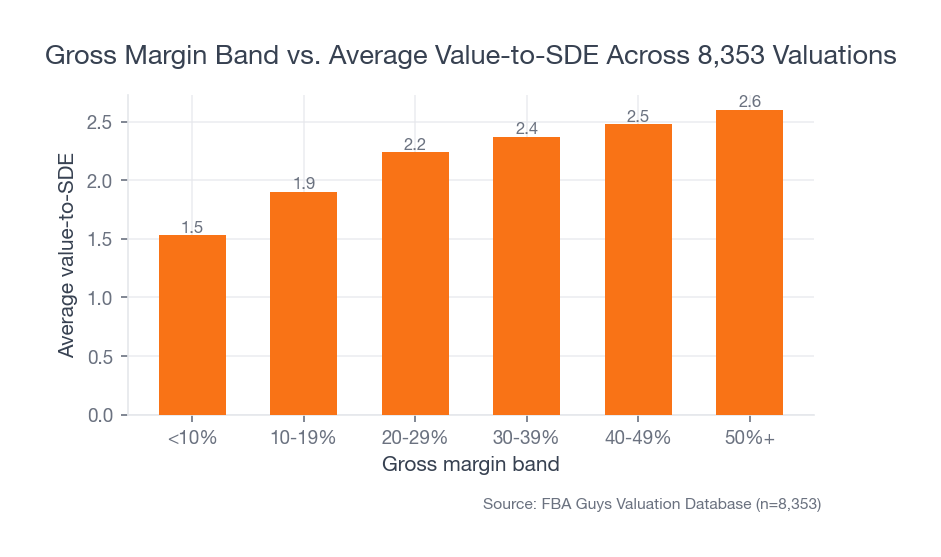
In the FBA Guys valuation database, the downstream pattern is pretty clear. Among 8,353 successful valuations with usable margin, SDE, and value data, businesses under 10% gross margin averaged 1.53 value-to-SDE. Businesses in the 20-29% gross margin band averaged 2.24. Businesses at 50%+ gross margin averaged 2.60.
That does not mean Amazon fees caused the valuation gap. The database does not store Seller Central fee deductions at the SKU level, and we are not going to pretend it does. It means margin room matters when the platform keeps adding little doors for cost to walk through.
 Source: FBA Guys Valuation Database (n=8,353)
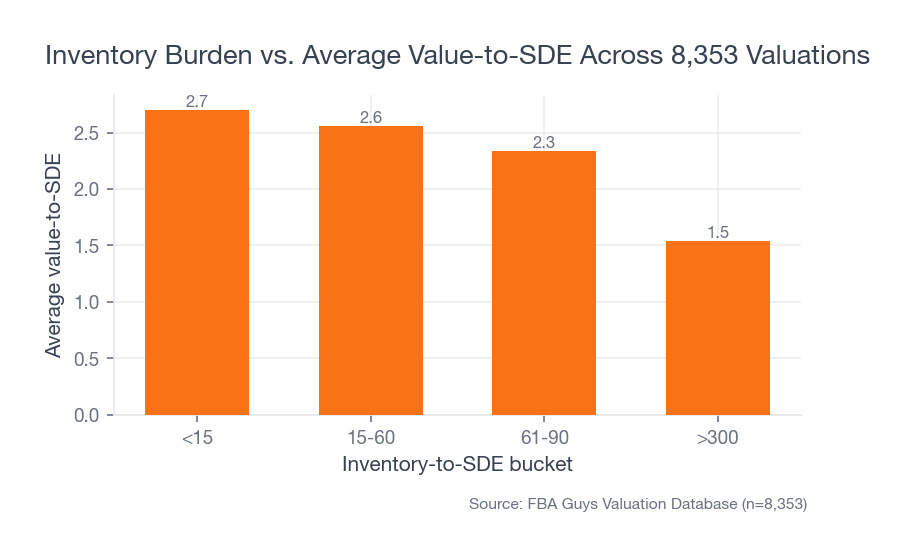
Inventory tells the same story with a different accent. Businesses with inventory under 15% of SDE averaged 2.70 value-to-SDE across 2,323 valuations. Businesses with inventory above 300% of SDE averaged 1.54 across 1,403 valuations.
This is where the fee timeline gets useful. Many of the modern Amazon fee changes are inventory behavior fees wearing different clothes. Inbound placement. Storage utilization. Aged inventory. Low inventory. Removal orders. Return processing when product quality and customer expectation drift apart.
The seller sees five separate fees. The buyer sees one operating pattern.
The fact is, a fee timeline only earns its keep when it changes the next operating review. Otherwise it is just a museum label for pain you already paid for.
The 2026 lesson: check the calendar twice
Amazon's October 2025 announcement for 2026 was relatively calm. It said average FBA fees would rise by about $0.08 per unit, effective January 15, 2026 unless otherwise noted, and that there would be no new FBA fee types in that annual update. For the base mechanics, start with our Amazon FBA fulfillment fee breakdown, then layer the 2026 surcharge on top.
Then April arrived.
Starting April 17, 2026, Amazon added a 3.5% fuel and logistics-related surcharge to FBA fulfillment fees in the US and Canada. Amazon said it would be calculated on fulfillment fees, not sale price, and would average $0.17 per US FBA unit.
Seventeen cents sounds harmless until it lands on a low-priced item, a bulky item, a catalog with thin contribution margin, or a seller already dealing with placement, storage, coupons, returns, PPC, and the small monthly ritual of wondering why the settlement report looks like it was assembled in a basement during a power outage.
This is why sellers should not treat the annual Amazon fee update as the only fee event of the year. It is the scheduled one. Scheduled is not the same as complete. The same logic applies to broader cost reviews, which is why our true cost of selling on Amazon FBA piece treats the rate table as only the first pass.
What changed from 2020 to 2026
The older fee changes were easier to understand because they lived in recognizable buckets. Fulfillment went up. Storage changed. Referral fees moved in certain categories. Removal and disposal fees adjusted.
The newer fee changes ask a more annoying question: how well do you operate?
That is why a clean Amazon FBA fee increases history timeline should not stop at "fees increased by X." The better questions are:
- Did the change hit all sellers, or only specific product types?
- Did it affect inbound, outbound, storage, returns, or category referral economics?
- Could the seller reduce exposure through behavior, or was the cost unavoidable?
- Did the change create a one-time adjustment or a permanent operating habit?
- Does the seller know the per-unit impact, or are they only watching account-level net proceeds?
The last one is the scar. We have seen sellers who understood the public fee table and still could not explain why the account was producing less cash. The missing dollars were not hidden in one dramatic line. They were smeared across placement, storage, returns, advertising, reimbursements, and inventory timing.
Nobody wants to buy "smeared across."
How sellers should use the timeline
Use the timeline as a review schedule, not trivia. For a broader checklist of the costs sellers tend to miss, see our guide to Amazon FBA hidden costs.
First, rebuild contribution margin after every fee event. Contribution margin is the money left after the direct costs of selling a unit, including Amazon referral fees, FBA fees, product cost, freight, duties, packaging, and other direct variable costs. If the product still looks good only because one Amazon fee is missing, the spreadsheet is not a spreadsheet. It is a mood board.
Second, separate fee exposure by SKU. Account averages hide the products that are quietly making the business worse. A 3.5% surcharge on fulfillment fees is not the same economic event for a $12 lightweight replenishable item and a $42 bulky product with frequent returns.
Third, audit inventory behavior. The database pattern is too large to ignore: inventory-light businesses in our sample averaged 2.70 value-to-SDE, while the heaviest inventory burden group averaged 1.54. Again, not causation. But buyers care when too much cash is trapped in inventory because every future fee change gets harder to absorb. The opposite mistake matters too, which is why the Amazon FBA low-inventory-level fee deserves its own review.
 Source: FBA Guys Valuation Database (n=8,353)
Fourth, document the response. If fees changed and you adjusted packaging, repriced certain SKUs, changed inbound routing, killed weak ASINs, or improved return rates, keep the record. A buyer does not need a speech about how hard Amazon is. They need evidence that the operator noticed, measured, and acted.
FAQ
What were the biggest Amazon FBA fee changes from 2020 to 2026?
The biggest shift was not one single increase. The major pattern was Amazon moving from broad annual fulfillment and storage adjustments toward more behavior-specific fees: inbound placement, low-inventory-level fees, storage utilization, expanded return processing, and fuel/logistics surcharges.
Did Amazon increase FBA fees in 2025?
For the 2025 US update, Amazon said it would not increase US referral and FBA fees, would not introduce new fee types, and would decrease some fees or add benefits. That came after a much heavier 2024 fee-structure change.
Did Amazon add a new FBA surcharge in 2026?
Yes. Starting April 17, 2026, Amazon added a 3.5% fuel and logistics-related surcharge to FBA fulfillment fees in the US and Canada. Amazon said the surcharge averages $0.17 per US FBA unit and applies to fulfillment fees rather than sale price.
How often should sellers review Amazon FBA fees?
At least after every annual fee announcement, every mid-year surcharge announcement, and every material SKU change. The better habit is monthly fee reconciliation by SKU, because the fee that hurts is usually the one that compounds quietly.
The timeline is a margin test
Amazon will keep changing the rate card. Some changes will raise costs. Some will lower a visible fee while adding a decision somewhere else. Some will arrive in the annual update. Some will land mid-year with a polite explanation and a new line in the calculator.
The seller's job is not to memorize every historical fee.
The job is to know which SKUs can survive the next one.
Curious what your business is worth?
Get a free, instant valuation and see how your Amazon business stacks up.
Get Your Free Valuation