Do I Need a CPA for My Amazon Business? The Answer Is Usually Yes, but Not for the Job You Think
The FBA Guys
April 16, 2026

Do I Need a CPA for My Amazon Business? The Answer Is Usually Yes, but Not for the Job You Think
An Amazon business can look financially simple right up until the month you try to explain it.
Revenue came in. Amazon took its fees. Inventory was ordered. Ads ran. A few apps renewed themselves in the background, because of course they did. Tax season should be a matter of handing over the reports and waiting for the return.
Then you open the P&L and find a $17,000 inventory purchase sitting in the wrong month, a freight invoice hiding under "supplies," a software stack spread across two credit cards, and a state notice that went to an old address because nobody updated the account after the LLC filing.
Do you need a CPA for your Amazon business? Usually, yes. But a CPA should not be used as a substitute for monthly e-commerce bookkeeping. A CPA is most useful for tax filing, entity structure, state obligations, payroll, S corp questions, and planning. Your day-to-day numbers need a bookkeeper who understands Amazon, inventory, and accrual accounting.
That split sounds fussy until the numbers stop tying out.
What a CPA Actually Does for an Amazon Seller
A CPA helps with the tax and planning questions that can get expensive quickly.
Entity structure. S corp election. Reasonable salary. Payroll setup. Estimated tax payments. State income tax questions. Sales tax exposure that Amazon marketplace facilitator rules don't fully settle. Tax-return preparation. Year-end review. Conversations about whether a decision creates a tax problem now or a cleanup problem later.
Those are real jobs.
They are also different from matching Amazon settlement reports to gross sales, fees, refunds, reimbursements, COGS, inventory, ad spend, and bank deposits every month. Many CPAs can review that work. Some can set it up. Fewer want to live inside it month after month.
The IRS small business tax center is a useful reminder of how many tax questions can sit around even a small operation. Entity, employment, estimated tax, deductions, recordkeeping, and information returns all have their own lives.
The Playbook makes the operating split plainly: the monthly data should be entered into QuickBooks Online or Xero by a bookkeeper, while the CPA reviews the P&Ls, helps with tax planning, and files the returns. It is not glamorous advice. It is just the system that tends to keep the business readable.
Why a Bookkeeper Is Different From a CPA
Amazon bookkeeping has a timing problem.
The cash leaves before the revenue arrives. Product cost belongs in inventory until the unit sells. Amazon deposits are net of fees, refunds, reimbursements, storage charges, ad spend, and a dozen smaller things that never ask permission before becoming accounting entries.
A seller who books only the bank deposit has a cash record. The business still needs an operating statement.
That is where an e-commerce bookkeeper earns the monthly fee. They separate gross sales from Amazon fees. They track COGS. They reconcile bank deposits. They keep inventory from behaving like a normal expense. They make sure the P&L says something about performance rather than payment timing. For a fuller foundation, start with Amazon FBA accounting basics and then move into the monthly view with an Amazon seller profit and loss statement.
A CPA can look at the tax outcome. The bookkeeper keeps the monthly record from getting strange in the first place.
The messy detail is usually small. A reimbursement shows up three weeks after the lost-unit claim. A sample order hits a personal card. A prep-center invoice includes inspection, labeling, storage, and forwarding in one line. None of that is dramatic. That is why it gets missed.
What the Data Says About Tax Readiness
Our valuation database doesn't have a clean field for "uses a CPA." It does have tax-return and documentation proxy fields, which are useful for a narrower question: how often does the business look ready to explain itself?
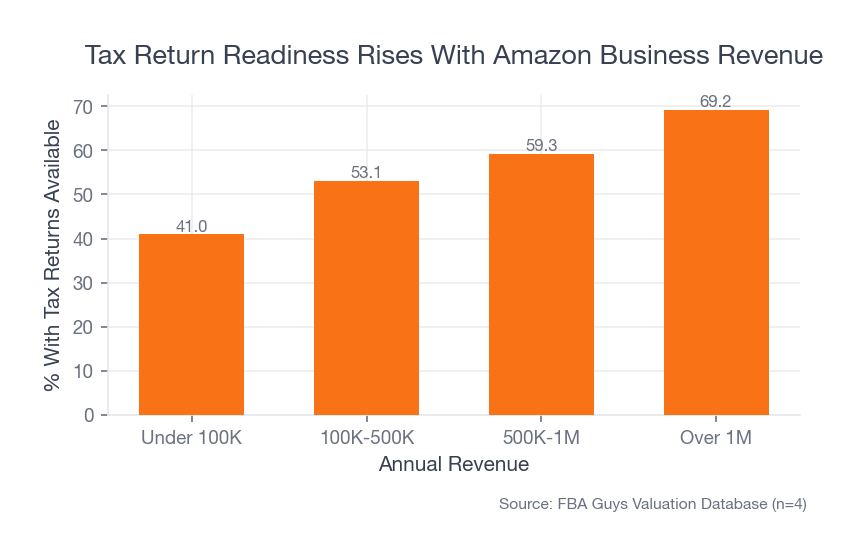
Among successful valuation submissions with sales data, tax returns were marked available for 41.0% of businesses under $100K in annual revenue. That rose to 53.1% from $100K to $500K, 59.3% from $500K to $1M, and 69.2% above $1M.
 Source: FBA Guys Valuation Database (n=8,428 successful submissions with sales data)
The pattern is not causal. Larger businesses tend to have more administrative pressure, more tax exposure, and more reason to hire help.
Still, the curve is useful. Tax readiness tends to show up more often as the business matures. The better version is to build it before the cleanup bill becomes its own line item.
When a CPA Becomes Worth Paying For
There are obvious triggers.
You form an LLC. You consider an S corp election. You hire employees. You start paying yourself through payroll. You sell in multiple states. You carry meaningful inventory. You finance purchase orders. You import goods. You receive a tax notice. You plan to sell the business. You have enough profit that estimated tax mistakes hurt.
At that point, the CPA fee is not just about compliance. It is about avoiding amateur decisions that look cheap until they have to be unwound.
The fact is, Amazon sellers can outgrow informal tax habits faster than they realize.
The scar here is familiar: a competent operator builds a real business, keeps the products moving, watches revenue climb, and still has to reconstruct the financial record later because the accounting system never caught up with the operation. That is not incompetence. It is a business growing through the owner's original setup.
Entity questions are a good example. LLC vs S corp for Amazon sellers is not a personality test. It is a tax, payroll, administrative, and owner-discipline question. A CPA belongs in that conversation before the election is made, not after the first messy payroll year.
What Your CPA Should Not Be Doing Alone
The most expensive accounting setup is the one where every professional assumes someone else is handling the details.
The CPA assumes the bookkeeper reconciled Amazon correctly. The bookkeeper assumes the CPA will catch tax treatment issues. The owner assumes both of them know that the March "software" charge was actually a one-time product-testing tool, the June contractor was the owner's cousin doing packaging design, and the December inventory deposit included freight for a shipment that didn't arrive until January.
Lovely.
This is why Amazon accounting needs a simple lane map. Your CPA should own tax filing, tax planning, entity decisions, state-level questions, payroll tax questions, estimated taxes, and year-end review. Your bookkeeper should own monthly categorization, reconciliation, inventory accounting support, Amazon settlement report mapping, and the recurring P&L. You, unfortunately, still own the facts.
No professional can classify an expense correctly if the business purpose is a mystery. The $2,400 legal bill might be trademark work, contract review, entity setup, or a personal estate planning invoice that hit the wrong card. The bookkeeper can place it in a category. The CPA can explain the tax treatment. Only the owner knows what happened.
The cleanest systems make that knowledge visible while it is still fresh.
One simple habit helps: keep a monthly notes file next to the books. Nothing fancy. Just a dated list of odd transactions, inventory deposits, owner reimbursements, new state registrations, loans, contractor changes, product samples, and anything that would make you squint six months later. The note can be ugly. The future explanation should not be.
This is where a CPA relationship gets much more useful. A CPA who sees a clean monthly close and a short list of real business questions can advise. A CPA who receives a shoebox of Amazon downloads and vague memories in March has to reconstruct. Reconstruction is slower, more expensive, and less likely to produce useful planning.
How Much Complexity Justifies a CPA?
Size matters, but complexity usually matters first.
A $40,000 side project with one product, no employees, no debt, one state, and clean books may not need much CPA time beyond annual filing and a quick planning call. A $90,000 seller importing inventory, testing an S corp, paying contractors, financing purchase orders, and storing goods in multiple states can create more questions than the revenue number suggests.
That is why the better trigger is not revenue alone. Look for friction.
Are you unsure whether inventory is being treated correctly? Are you making estimated tax payments from guesswork? Are you moving money between personal and business accounts because cash is tight? Are you considering payroll? Did a state send you a letter? Are you using cash-basis reports because they are easy even though inventory is driving the business? Are you planning to apply for financing or sell within the next two years?
Those are CPA questions.
Some sellers wait because they want the business to be "worth it" first. We understand the instinct. Nobody wants to spend professional fees on a business that may still be proving itself.
The danger is that the cleanup cost does not wait politely. It compounds in little ways. A missing receipt here. A COGS method that changes midyear. A personal card used for sample orders. A state registration opened but never reconciled to filings. A contractor paid without the right paperwork. The business can still be profitable while quietly making the future mess larger.
There is a middle ground. Hire the bookkeeper first if the monthly numbers are the weak point. Bring in the CPA for a setup review, entity discussion, estimated tax planning, and year-end filing. Increase the CPA involvement as the business adds payroll, states, financing, imports, or sale planning.
That staged approach is less dramatic than waiting until everything is on fire.
What to Have Ready Before You Hire a CPA
Before you bring in a CPA, gather the boring material.
Business entity documents. Prior tax returns. Bank statements. Credit card statements. Amazon settlement reports. Inventory records. Payroll details. Loan documents. Software subscriptions. Sales tax registrations. State notices. A monthly P&L, if you have one. A balance sheet, if it is not terrifying.
If you don't have those, say so directly. A good CPA can work with messy history, but nobody benefits from pretending the books are cleaner than they are.
This is also where the bookkeeper becomes useful before the CPA meeting. A CPA can give better advice when the monthly numbers already separate Amazon fees, advertising, inventory, COGS, owner draws, payroll, and reimbursable expenses. If inventory is the fuzzy part, tracking COGS for Amazon FBA is the place to tighten first.
How This Affects Valuation Later
Clean tax and accounting records matter because they make earnings easier to believe.
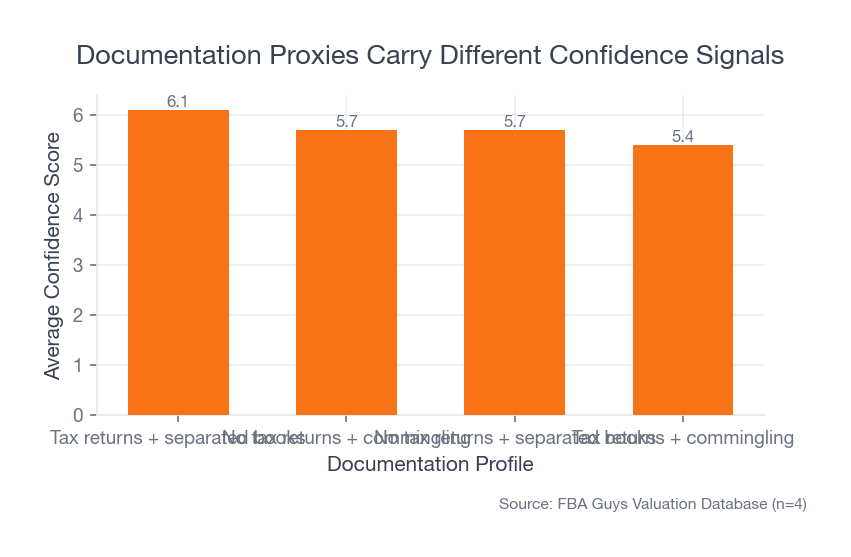
In the database, businesses marked SBA eligible averaged a 6.4 confidence score. Not-eligible businesses averaged 5.4. Documentation is not the only thing inside that derived field, but the direction makes sense.
The same pattern appears when tax returns and separated books travel together. Businesses with tax returns available and separated business financials averaged 6.1 confidence. Tax returns with commingling averaged 5.4.
 Source: FBA Guys Valuation Database (n=5,596 successful submissions with tax-return and financial-separation fields)
If you may ever sell, a CPA and a bookkeeper are not just tax vendors. They are part of how your business explains itself to someone else. That same principle sits underneath Amazon seller tax deductions: the write-off helps only when the record survives contact with the books.
A Simple CPA Decision Framework
Use this as a practical filter, not tax advice.
If your Amazon business is pre-profit, single-state, and still experimental, start with clean separation. Open the business bank account. Use one business credit card. Track every Amazon deposit properly. Keep inventory records. Don't let personal spending drift into the books just because the business is small.
If the business is profitable and you are filing a Schedule C or entity return, get at least an annual CPA review. Ask about estimated taxes, entity structure, deductions, inventory treatment, and state obligations. You may not need monthly CPA attention yet, but you need someone qualified looking at the tax position.
If the business has payroll, an S corp election, multi-state exposure, financing, imports, meaningful inventory, or a planned sale, make the CPA part of the operating calendar. Quarterly is often a better rhythm than once a year because the decisions are still adjustable.
And if the books are already messy?
Start there. Hire the e-commerce bookkeeper, get the settlement reports mapped, reconcile the accounts, clean up inventory treatment, and then bring the CPA into a set of numbers that can be reviewed. A CPA can help with cleanup, of course, but asking them to do tax planning from broken books is like asking someone to draw a map while the table is wobbling.
One more thing: choose a CPA who is comfortable saying, "I need to see the bookkeeping before I answer that." That answer can feel less satisfying in the moment. It is often the honest one.
FAQ
Do I need a CPA if Amazon collects sales tax?
Often, yes. Amazon collecting sales tax through marketplace facilitator rules doesn't automatically answer every filing, registration, income tax, payroll, nexus, or state obligation question. The state-by-state issue is bigger than one checkout setting, which is why Amazon FBA tax obligations by state deserves its own review.
Can my CPA do my bookkeeping?
Sometimes. The better question is whether they regularly handle Amazon seller bookkeeping, settlement reports, landed COGS, inventory, and monthly accrual books. If not, use an e-commerce bookkeeper and let the CPA review.
When should I hire a CPA for my Amazon business?
Hire one before entity changes, S corp elections, payroll, multi-state issues, meaningful profit, tax notices, financing, or a planned sale. Waiting until March gives the CPA less room to help.
Is a bookkeeper enough?
A bookkeeper is enough for monthly categorization and reconciliation if they understand e-commerce. A CPA is still useful for tax filing, tax planning, entity decisions, and questions that create legal or tax consequences.
What should I ask a CPA before hiring them?
Ask whether they work with Amazon sellers, how they handle inventory and COGS, whether they coordinate with an e-commerce bookkeeper, how they approach entity and S corp questions, and what records they expect you to provide monthly. The answer should be specific. "Send us everything at year-end" is not much of a system.
Should I hire a CPA before I start selling on Amazon?
Not always. If the business is tiny and still experimental, clean bank separation and basic bookkeeping may be the first step. A CPA becomes more useful once there is profit, entity complexity, payroll, inventory scale, financing, state exposure, or a decision that could be hard to unwind.
The best CPA relationship is boring most of the year. That is the point.
Curious what your business is worth?
Get a free, instant valuation and see how your Amazon business stacks up.
Get Your Free Valuation